NZ Home Down Payment Calculator
Enter Your Details
Can $3000 really be enough to buy a house in New Zealand? If you're asking this question, you're not alone. Thousands of first-time buyers are staring at their savings, wondering if that $3000 is just a drop in the ocean-or the first brick in their future home. The truth? It’s not about the number alone. It’s about where you live, what kind of house you want, and how the system works right now.
What Does a Down Payment Actually Cover?
A down payment isn’t just a fee you hand over to the seller. It’s your stake in the property. In New Zealand, lenders typically require at least 10% of the home’s purchase price as a down payment. That means if you’re looking at a house priced at $30,000, $3000 would cover it. But that house doesn’t exist. Not anymore.
The average house price in Auckland as of early 2026 is $920,000. In Wellington, it’s $810,000. Even in smaller towns like Hamilton or Tauranga, prices hover around $700,000. That means a 10% down payment? You’d need $70,000 to $92,000. $3000? That’s less than 1% of the cost. You’d need to find a home under $300,000 to make it work-and those are rare.
Where Could $3000 Actually Work?
You might be thinking: "But what about rural areas? What about sections? What about fixer-uppers?" And yes, there are places where $3000 could be part of the story.
In some parts of the Bay of Plenty, Gisborne, or the Far North, you can find small rural sections or old farm cottages listed under $250,000. Even then, lenders usually won’t approve a mortgage without at least 5% down. That’s $12,500. So $3000 alone still won’t cut it. But here’s the twist: if you’re eligible for the First Home Loan scheme, you might only need 5% down-and if you qualify for a government subsidy or a family gift, $3000 could be your contribution toward that 5%.
Some buyers use $3000 as their initial deposit to lock in a section, then build over time. Others use it to cover legal fees or building inspections while waiting for savings to grow. In those cases, $3000 isn’t the down payment-it’s a stepping stone.
Government Help: What’s Actually Available?
New Zealand has a few programs designed to help first-time buyers. The most relevant one is the First Home Loan, run by Kāinga Ora. It lets you put down as little as 5% if your income is below $120,000 (single) or $180,000 (couple). You also need to meet the regional house price cap: $700,000 in Auckland, $600,000 in Wellington, and lower elsewhere.
There’s also the First Home Grant, which gives you up to $10,000 if you’re buying an existing home or $15,000 if you’re building. To qualify, you need to have saved at least 5% of the purchase price over 12+ months. So if you’ve saved $3000, you’re halfway to the minimum-but you’d still need another $7,000 to $12,000 to qualify for the grant.
And if you’re buying with a partner? Combine your savings. $3000 from each person? That’s $6000. Still not enough for a 10% deposit on a $1 million house-but it could be part of a larger plan, especially if you’re eligible for both the loan and the grant.
What Are Your Realistic Options?
If you’ve only got $3000 saved, here’s what actually works:
- Start with a section-buy land, then build. Some developers offer land-only deals under $100,000. That means you’d need $5000-$10,000 for a 10% deposit. You can build slowly, using a construction loan.
- Look outside major cities-in places like Whanganui, Nelson, or even parts of Hawke’s Bay, you can find homes under $500,000. A 5% deposit here is $25,000. Still a big jump from $3000, but not impossible with a grant or family help.
- Join a shared ownership scheme-some non-profits let you buy 25%-50% of a home, with rent on the rest. Your $3000 could cover part of your initial share. This isn’t full ownership, but it gets you on the ladder.
- Work with a mortgage broker-they know which lenders are flexible. Some credit unions offer 95% loans for first-time buyers with strong income and low debt.
Why 00 Isn’t the Real Problem
The real issue isn’t your $3000. It’s the gap between what you’ve saved and what the market demands. Most first-time buyers don’t have $70,000 saved. They don’t have $30,000. They have $5000, $10,000, $15,000. And they’re still finding ways in.
The trick? Don’t focus on the deposit number. Focus on the path. Can you get a grant? Can you use KiwiSaver? Can you buy with a partner? Can you start with land? Can you wait a year and double your savings by cutting rent, side gigs, or budgeting hard?
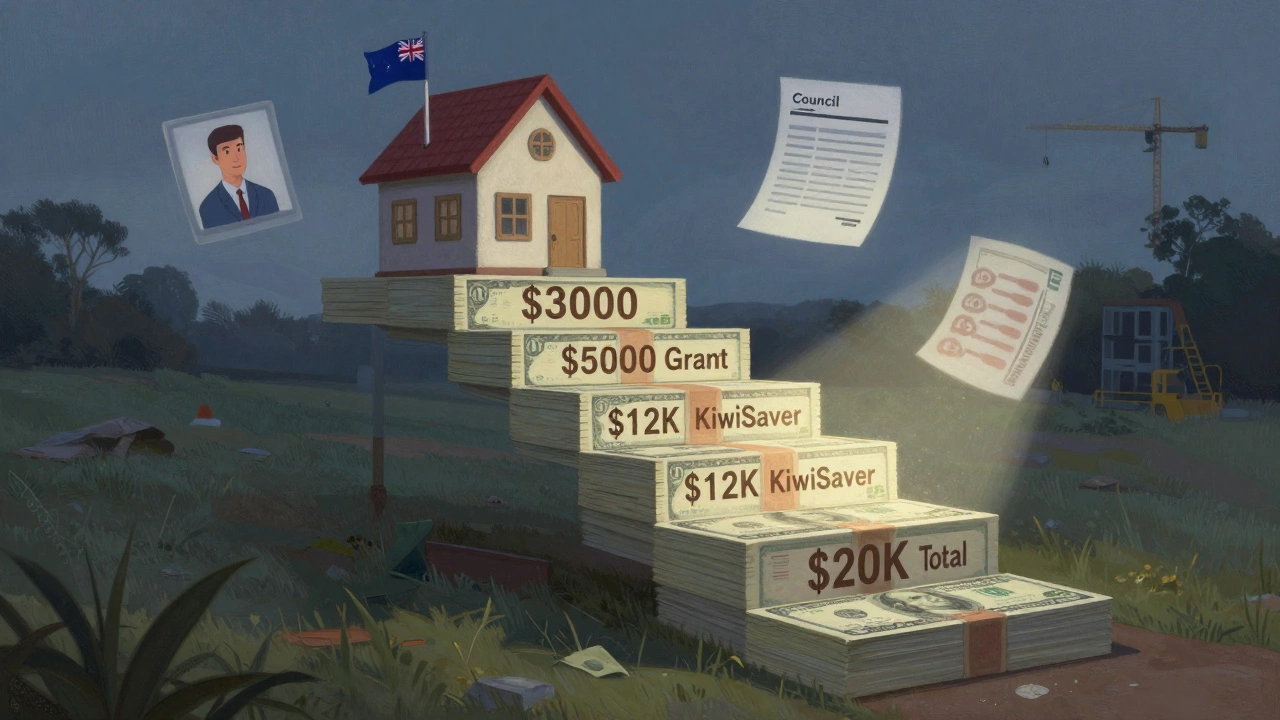
One buyer in Christchurch saved $3000 over 6 months. Then she got a $5000 government grant, pulled $12,000 from her KiwiSaver, and used a 90% loan. She bought a 1970s bungalow for $410,000. Her total out-of-pocket? $20,000. $3000 was just the start.
What Should You Do Next?
If you’ve got $3000 and you’re serious about buying:
- Check your KiwiSaver balance-you can use it for a deposit if you’ve been contributing for 3+ years.
- Use the Kāinga Ora First Home Loan calculator to see if you qualify.
- Apply for the First Home Grant-your local council can help you fill out the forms.
- Talk to a mortgage broker. Not a bank. A broker. They work with 10+ lenders and know which ones are willing to bend rules for first-time buyers.
- Set a 12-month savings goal. Even $500 a month gets you $6000 in a year. Add your $3000? That’s $9000. Suddenly, you’re not far off.
There’s no magic number. $3000 won’t get you a house. But it can be the first step in a much bigger plan. Many people who bought homes in 2025 started with less than $5000. They didn’t wait for perfect savings. They started with what they had-and built from there.