
Shared Ownership Cost Calculator
Calculate Your Shared Ownership Costs
Your Monthly Costs
$0
$0
$0
$0
Staircase Progress
When you hear the term "shared ownership," it might sound like splitting a house with a friend. But in real estate, it’s a structured way to buy a home when you can’t afford the full price. So what’s the actual name for your piece of that home? It’s called an equity share.
What Exactly Is an Equity Share?
An equity share is the percentage of a property you own outright. If you buy a 25% equity share in a home, you own a quarter of it. The rest is owned by a housing association or government-backed body. You pay rent on the portion you don’t own. This isn’t a rental agreement like you’d have with a landlord - it’s a legal ownership split.
In New Zealand, shared ownership schemes are still emerging, but they’re growing fast. Cities like Auckland and Wellington have pilot programs where first-time buyers can get into homes with as little as 5% upfront. Your equity share is recorded on the title deed. It’s yours to sell, increase, or pass on - just like full ownership.
How Does It Work in Practice?
Let’s say you’re looking at a $600,000 home. You can’t afford the full price, but you have $30,000 saved. With shared ownership, you might buy a 5% equity share - that’s $30,000. The housing provider owns the other 95%. You pay a mortgage on your 5% share and rent on the remaining 95%.
Monthly payments? They’re usually lower than full rent because part of what you pay goes toward building equity. In Auckland, typical monthly costs for a 10% share on a $700,000 home might be around $1,100 - $700 for rent on the 90% you don’t own, and $400 for your mortgage. That’s often cheaper than renting a similar apartment outright.
Can You Buy More Later?
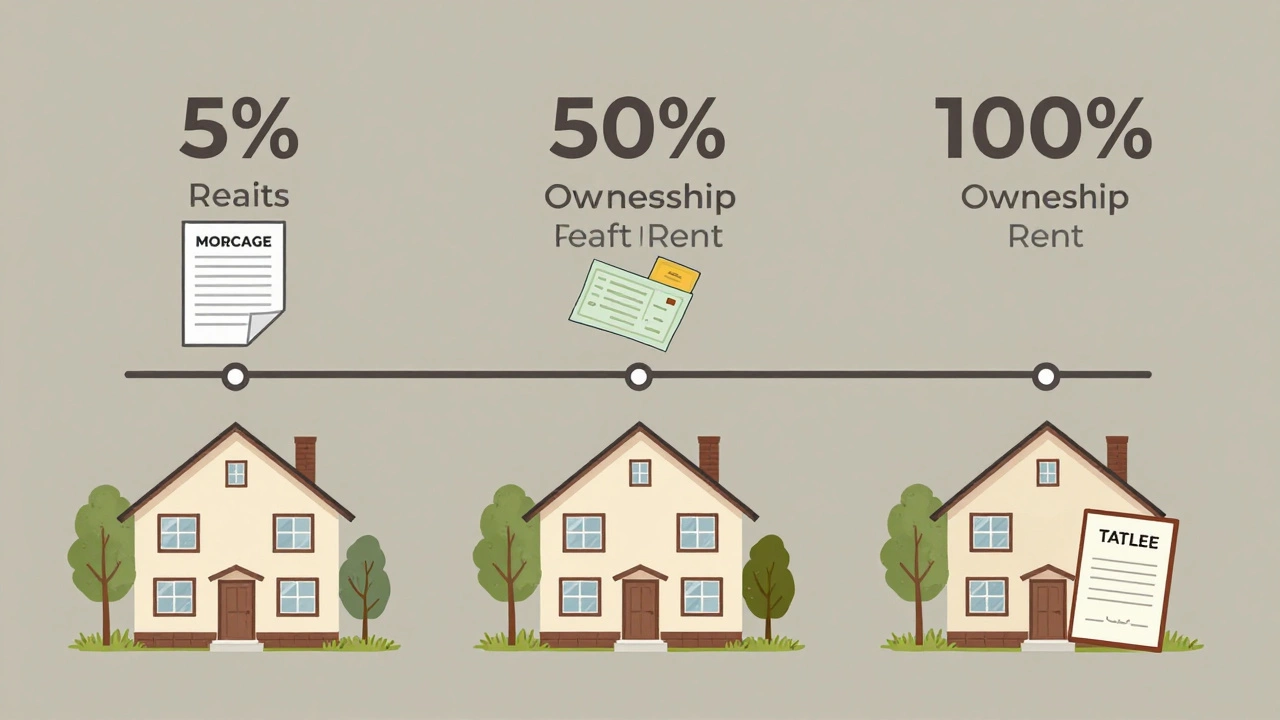
Yes - and this is where shared ownership gets powerful. The process of buying more of your home is called staircasing. You can buy additional equity shares in increments, usually 5% or 10% at a time. Each time you do, your rent goes down because you own more.
After a few years, many people staircase up to 100% ownership. Once you own the whole property, you stop paying rent. You’re just a regular homeowner with a mortgage. Some schemes let you staircase all the way up - others have limits. Always check the terms before signing.
What’s the Difference Between an Equity Share and a Leasehold?
People often confuse equity shares with leasehold. They’re not the same.
- An equity share means you own a portion of the property’s value. You’re a part-owner.
- A leasehold means you’re renting the right to live in a property for a set number of years - you don’t own any of it.
In shared ownership, you hold an equity share. You’re not a tenant. You’re a co-owner. That gives you rights: you can make renovations (with approval), you can sell your share, and you can eventually own it all.
Who Offers Shared Ownership in New Zealand?
Right now, shared ownership is mostly offered through government-backed housing providers like Kāinga Ora and a few non-profit housing trusts. Private developers are starting to join in, especially in Auckland’s outer suburbs where land is more affordable.
These programs usually require:
- First-time buyer status (no other property owned)
- Income under a set threshold (usually $120,000 for singles, $180,000 for couples)
- Good credit history and stable employment
- Completion of a financial readiness course
Some schemes even offer help with legal fees or stamp duty (called land transfer tax here).
What Happens If You Want to Sell?
If you decide to move, you can sell your equity share. The housing provider usually has the first right to buy it back. If they don’t, you can list it on the open market. You keep all the profit from your share’s increase in value.
For example: You bought a 20% share in a $500,000 home. You paid $100,000. Five years later, the home is worth $700,000. Your 20% share is now worth $140,000. You sell it and pocket the $40,000 gain. The housing provider gets their 80% share back - they don’t get a cut of your profit.

Common Misconceptions
There are a few myths about shared ownership that keep people away:
- "It’s a trap." No. You’re not locked in. You can staircase, sell, or even walk away - though you might lose money if the market drops.
- "You’ll pay more in rent." Actually, rent is often lower than market rates because the provider doesn’t aim for profit.
- "You can’t get a mortgage." Many banks now offer shared ownership mortgages. Lenders like KiwiBank and ANZ have specific products for this.
- "It’s only for low-income people." Not true. Many middle-income families use it to get into the market faster.
Why This Matters in 2026
House prices in Auckland are still over 8 times the average income. First-time buyers are waiting longer than ever. Shared ownership isn’t a workaround - it’s becoming a mainstream path into homeownership.
Over 1,200 New Zealanders entered shared ownership homes in 2025. That’s up 67% from 2023. The government’s goal is to hit 5,000 new shared ownership homes by 2028.
If you’re tired of renting, or if you’ve been saving for years without progress, an equity share might be the missing piece. You don’t need to own everything at once. You just need to own a piece.
What’s Next?
Start by checking if you qualify on the Kāinga Ora website. Attend a free shared ownership workshop - they’re offered monthly in Auckland, Hamilton, and Christchurch. Talk to a housing advisor. Get your finances in order. And remember: your first share doesn’t have to be big. It just has to be real.