
50% Rule Calculator for NZ Landlords
Calculate Your Rental Expense Ratio
See if your property expenses align with the 50% rule guideline for NZ landlords.
Use this tool to see if your property's expenses are within the 50% rule guideline for NZ landlords.
When you’re renting out a property in New Zealand, you don’t just collect rent and call it a day. There’s a hidden math behind whether your investment actually makes sense - and the 50% rule is one of the simplest ways to check if you’re on track. It’s not a law, not a government guideline, but a rule of thumb used by thousands of landlords across Auckland, Wellington, and Christchurch to avoid costly surprises.
What Exactly Is the 50% Rule?
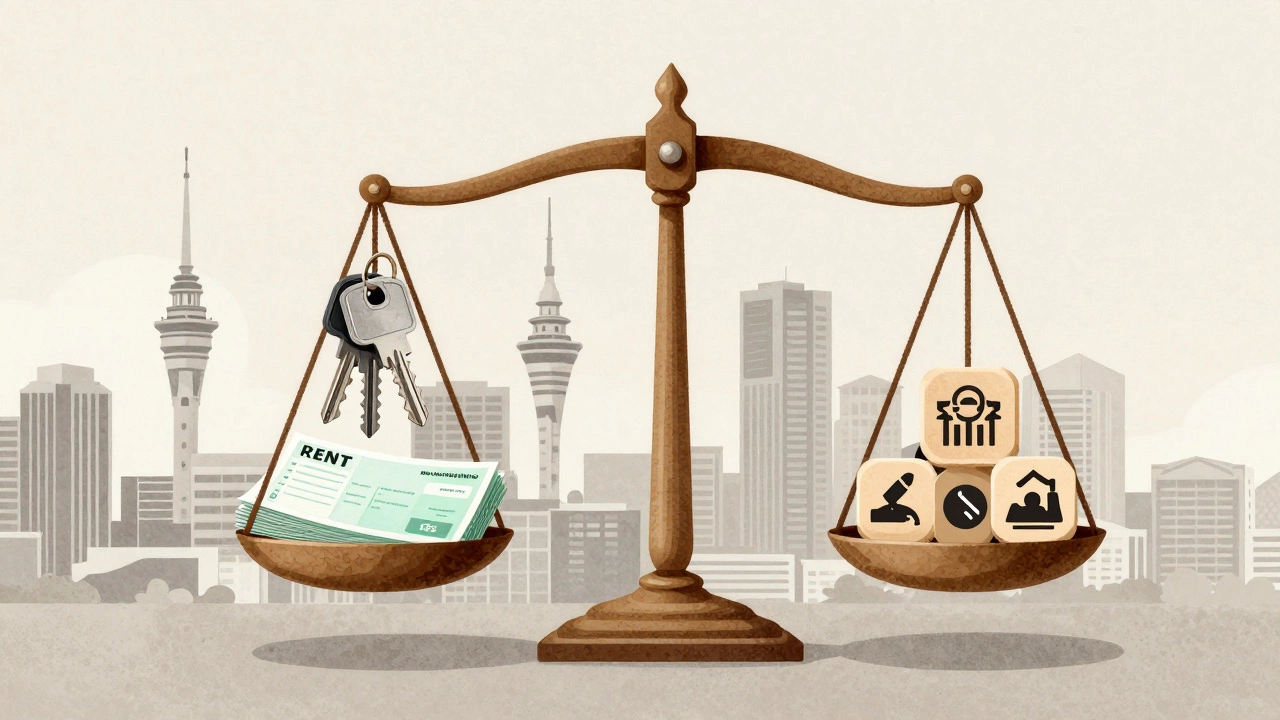
The 50% rule says that about half of your gross rental income will go toward operating expenses. That means if you collect $2,000 a month in rent, you should expect to spend roughly $1,000 on things like repairs, property management, insurance, rates, utilities, and maintenance. The other $1,000 is what’s left for your profit, mortgage payment, and taxes.
This rule doesn’t include your mortgage principal payment. Only the interest portion counts as an expense. So if your mortgage is $1,500 a month and $1,200 of that is interest, you’d subtract that from your $1,000 leftover - leaving you with only $200 in cash flow. That’s why the 50% rule isn’t about how much you make, but whether you’re making enough to cover real costs.
Why This Rule Matters in New Zealand
In Auckland, where rental yields are often below 4%, many new investors think they’re doing well because rent covers their mortgage. But they forget about the other costs. A cracked tile, a broken hot water cylinder, or a vacancy between tenants can wipe out your profit fast.
A 2024 study by the Real Estate Institute of New Zealand showed that 68% of first-time landlords underestimated their annual maintenance costs by at least 30%. The average landlord spent $1,800 a year on repairs - not including rates, insurance, or management fees. That’s more than $150 a month. Add $100 for insurance, $80 for rates, and $200 for property management, and you’re already at $530. That’s close to half of a $2,000 rent.
The 50% rule forces you to face reality. It’s not about being pessimistic - it’s about being prepared.
What Expenses Are Included?
Here’s what the 50% rule covers:
- Property management fees (typically 8-12% of rent)
- Insurance (building and landlord liability)
- Local council rates and water charges
- Repairs and maintenance (plumbing, electrical, painting, appliance fixes)
- Utilities if you pay them (internet, power, water for common areas)
- Landlord licensing fees (where required, like in Wellington)
- Advertising for new tenants
- Legal or accounting costs tied to the rental
What’s NOT included? Your mortgage principal, capital improvements (like a new kitchen or roof), or income tax. Those are separate. The 50% rule is only about ongoing, predictable operating costs.
How to Test Your Property Against the Rule
Here’s how to apply it in three simple steps:
- Find your gross monthly rent. Use current market rates, not what your tenant is paying now.
- Multiply that by 0.5. That’s your target expense budget.
- Add up your actual monthly expenses from last year. If you’re under or close to that number, you’re in good shape. If you’re over, you need to either raise rent, cut costs, or reconsider the investment.
Let’s say you own a two-bedroom unit in Manukau renting for $1,800/month.
- 50% of $1,800 = $900
- Your actual expenses: $150 (management) + $120 (insurance) + $90 (rates) + $200 (repairs) + $80 (advertising) = $640
You’re at 36% of rent in expenses - well under the 50% rule. That’s a healthy property.
Now, another landlord in Ponsonby has a $3,200/month rent. They thought they were doing great - until they added up:
- Management: $320
- Insurance: $200
- Rates: $150
- Repairs: $400
- Utilities: $100
- Advertising: $120
- Total: $1,290
That’s 40% of rent - still under 50%. But notice how the repair bill spiked. If that keeps rising, they could hit 50% fast. That’s the warning sign.
When the 50% Rule Doesn’t Work
The rule isn’t perfect. It’s a shortcut, not a financial model. Here are cases where it falls short:
- New builds: If your property is less than 5 years old, repairs will be low. You might only spend 20-30% of rent. That’s good - but don’t assume it’ll stay that way.
- High-end properties: Luxury rentals in Remuera or Devonport often have lower turnover and fewer repairs, but higher insurance and rates. The rule still applies, but your margin is thinner.
- Self-managed properties: If you handle everything yourself, you save on management fees. That means you might only spend 30-40% of rent. But you’re trading cash for time. That’s fine - just know what you’re giving up.
- Short-term rentals: Airbnb-style rentals have higher cleaning, turnover, and maintenance costs. You might spend 60-70% of income. The 50% rule doesn’t fit here.
Use the 50% rule as a baseline - not a final answer.
What to Do If You’re Over 50%
If your expenses are eating more than half your rent, you have three options:
- Raise the rent: Check what similar properties are renting for. If your tenant is on a fixed-term lease, wait until renewal. In Auckland, rents rose 8% year-over-year in 2024.
- Reduce costs: Switch to a cheaper property manager. Negotiate insurance. Do minor repairs yourself. Replace old appliances with energy-efficient ones to lower utility bills.
- Reconsider the investment: If the math still doesn’t work after adjustments, you might be better off selling. Holding onto a money pit hurts more than you think.
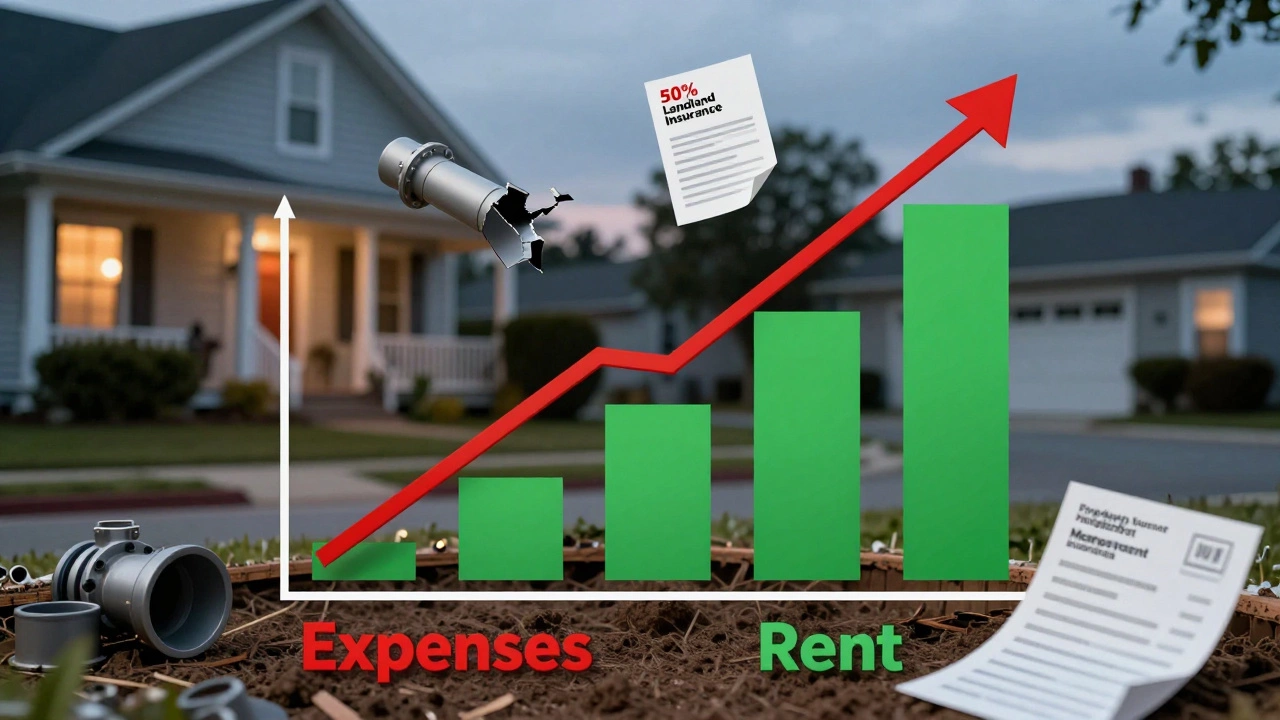
One landlord in Henderson bought a property for $780,000. Rent was $2,400/month. He thought he was making $1,000 profit after mortgage. Then he realized he was spending $1,300 on expenses. He was losing $300 a month. He sold it six months later and bought a smaller place in Manurewa with better cash flow.
How to Use the Rule to Find Better Deals
The 50% rule isn’t just for checking existing properties - it’s a tool to spot good buys.
When you’re looking at a new rental, ask: What’s the estimated rent? What’s the likely monthly expense? If the rent is $1,800 and the expenses are $1,100, you’re already over 60%. That’s a red flag.
Look for properties where rent is high relative to purchase price. A $600,000 home renting for $2,000/month has a 4% yield - decent. But if expenses are $1,000, you’re left with $1,000 for mortgage and tax. If your mortgage payment is $2,500, you’re losing money. The 50% rule helps you see that before you sign.
Use it alongside other tools: gross rental yield (rent ÷ purchase price × 100), net yield (after expenses), and cash flow. The 50% rule is your first filter.
Real-Life Example: Auckland vs. Tauranga
Two investors bought identical two-bedroom units in 2023 - one in Mt Roskill, one in Tauranga.
Mt Roskill: Bought for $850,000. Rent: $2,100/month. Expenses: $1,150/month (management, insurance, rates, repairs). That’s 55% - barely above the rule. Cash flow after mortgage interest ($1,400): -$450. Negative cash flow. They’re relying on capital growth.
Tauranga: Bought for $620,000. Rent: $1,900/month. Expenses: $850/month. That’s 45% - under the rule. Mortgage interest: $1,100. Cash flow: $150/month. They’re making money while they wait.
The Tauranga property is a better investment by the 50% rule. It doesn’t have the same growth potential, but it’s sustainable.
Final Tip: Track Everything
The biggest mistake landlords make? Not tracking expenses. They remember the big repair - but forget the $40 light switch replacement or the $60 cleaning fee after a tenant left.
Use a free app like Landlord Studio or even a simple spreadsheet. Record every dollar spent. At the end of the year, divide total expenses by total rent. If it’s above 50%, you’ve got work to do.
The 50% rule won’t make you rich overnight. But it will keep you from going broke trying.
Is the 50% rule a legal requirement in New Zealand?
No, the 50% rule is not a legal requirement. It’s a practical guideline used by investors to estimate expenses. New Zealand has no official rule about how much of your rental income should go to costs. However, the Inland Revenue Department does require you to accurately report all rental income and expenses when filing your tax return.
Does the 50% rule include mortgage payments?
No, the 50% rule only includes operating expenses like repairs, insurance, rates, and management fees. Your mortgage principal payment is not an expense - it’s building equity. Only the interest portion is counted as an expense for tax and cash flow purposes, but even that’s not part of the 50% calculation. The rule focuses purely on recurring costs you pay to keep the property running.
Can I use the 50% rule for Airbnb or short-term rentals?
Not really. Short-term rentals like Airbnb typically have much higher expenses - cleaning between guests, turnover costs, platform fees, and more frequent repairs. Many hosts spend 60-70% of income on operations. The 50% rule is designed for long-term tenancies. If you’re doing short-term, use a 65-70% expense estimate instead.
What if my property is new and I’m spending less than 50%?
That’s great - but don’t assume it’ll last. New properties have lower repair costs, but as they age, maintenance increases. A 3-year-old house might only need $300 a year in repairs. By year 10, that could jump to $1,500. Use the 50% rule as a long-term target, not a snapshot of your first year.
How does the 50% rule compare to the 1% rule?
The 1% rule says your monthly rent should be at least 1% of the property’s purchase price. For a $500,000 home, rent should be $5,000. That’s unrealistic in New Zealand. The 50% rule is more practical because it focuses on expenses, not just rent-to-price ratios. Many NZ properties rent for less than 1% of their value, but still make money if expenses are low. The 50% rule gives you a clearer picture of profitability.