Mortgage Affordability Calculator
Estimate Your Home Costs
Your Results
Monthly Mortgage Costs
Principal & Interest:
Property Tax:
Insurance:
PMI (if applicable):
Total Monthly Housing Cost:
Debt Ratios
Front-End Ratio:
Back-End Ratio:
Important Note: This calculator uses national averages for mortgage rates (6.8% fixed) and assumes 30-year term. Actual rates may vary based on credit score, lender, and market conditions.
What lenders look for: Front-end ratio (housing costs) should be ≤ 28% of gross income. Back-end ratio (all debts) should be ≤ 36-43% of gross income.
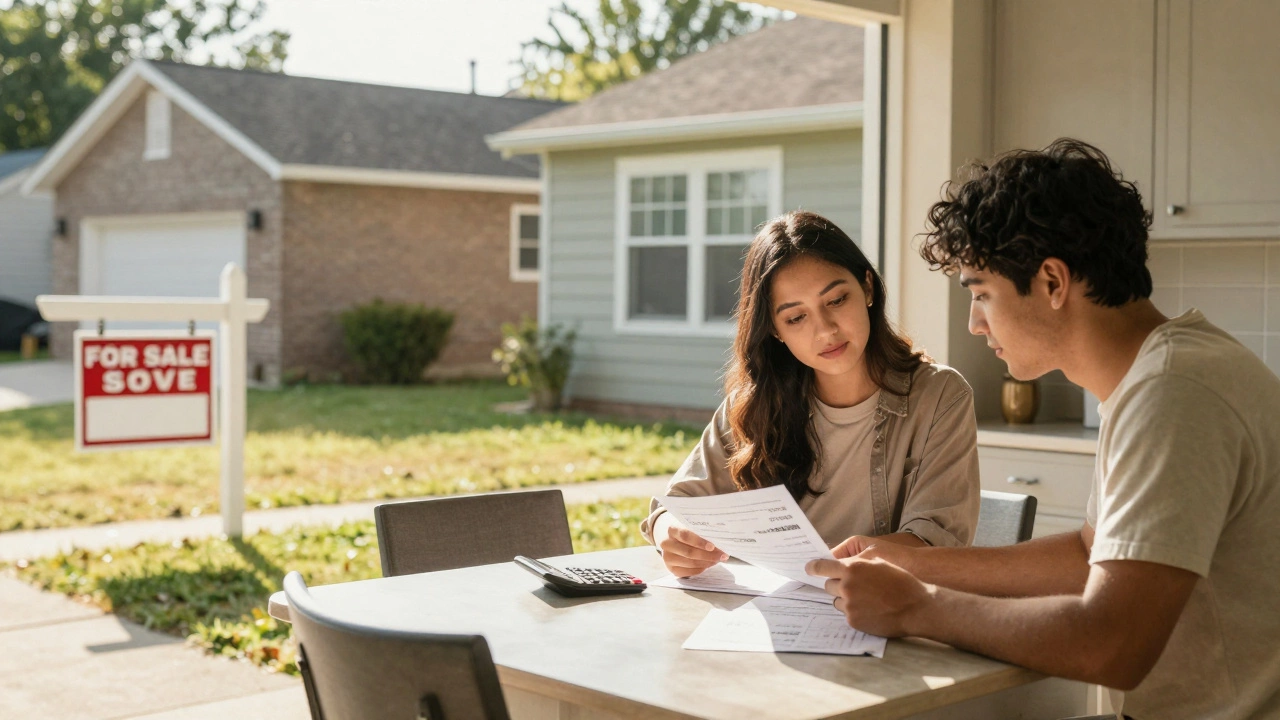
Buying a $250,000 house on a $50,000 salary isn’t impossible-but it’s not easy either. Many first-time buyers assume they need a six-figure income to own a home, but that’s not true. The real question isn’t whether you can afford it-it’s whether you should, given your other debts, savings, and lifestyle. Let’s break it down with real numbers, not guesses.
What Does a $250k Mortgage Actually Cost?
Let’s say you put down 10%-$25,000-on a $250,000 home. That leaves a $225,000 mortgage. At today’s average 30-year fixed rate of 6.8% (as of early 2026), your monthly principal and interest payment would be about $1,480.
But that’s not the whole picture. You also need to pay:
- Property taxes: Roughly $250-$400/month depending on your state. In states like Texas or Illinois, it’s closer to $400. In states like Alabama or Louisiana, it’s under $200.
- Homeowners insurance: $100-$150/month. If you live in a high-risk area (coastal, wildfire zone), it could hit $200.
- Private Mortgage Insurance (PMI): Since you put down less than 20%, you’ll pay PMI. On a $225k loan, that’s about $100-$150/month.
Add it all up: $1,480 + $300 (taxes + insurance) + $125 (PMI) = $1,905/month.
That’s your minimum housing cost. No repairs, no furniture, no yard work-just the mortgage, taxes, and insurance.
Can You Really Afford $1,905 a Month on $50k?
Your gross monthly income is $4,167 ($50,000 ÷ 12). Lenders use a rule called the front-end ratio: they want your housing payment to be no more than 28% of your gross income. 28% of $4,167 is $1,167.
You’re already at $1,905-far above that limit.
But lenders also use the back-end ratio: total debt payments (housing, car loans, student loans, credit cards) shouldn’t exceed 36-43% of your income. Let’s say you have a $300/month car payment and $200 in student loan payments. That’s $500 in other debt. Add that to $1,905 = $2,405 total monthly debt.
$2,405 ÷ $4,167 = 57.7%. That’s way over the 43% ceiling most lenders allow.
So unless you have zero other debt and a perfect credit score (760+), you won’t qualify for this loan under standard guidelines.
What If You Put Down More?
What if you saved up 20%? That’s $50,000. Suddenly, your loan drops to $200,000. Monthly payment drops to $1,315 (principal + interest). PMI disappears. Taxes and insurance stay the same: $300. Total: $1,615/month.
Still too high. 1,615 ÷ 4,167 = 38.7%. That’s above the 36% threshold many lenders prefer. You’d need to cut other debt to almost nothing to qualify.
And $50,000 in savings? That’s not common. The median savings for Americans under 35 is under $10,000. Saving $50k on a $50k salary means living on $2,000 a month for over two years. That’s doable-but only if you’re in a low-cost area, have no kids, and no car payments.
Where You Live Makes All the Difference
A $250,000 home in rural Ohio or West Virginia is a nice three-bedroom house with a yard. In San Francisco or New York City, it’s a tiny studio with no parking. In cities like Atlanta, Nashville, or Indianapolis, it’s a solid starter home.
Property taxes vary wildly. In New Jersey, you might pay $600/month. In Wyoming? $120. That’s a $480 difference every month. That’s almost half your mortgage payment.
Insurance matters too. In Florida, hurricane risk drives premiums up. In Colorado, wildfire zones do the same. If you’re in a high-risk zone, your monthly cost could jump $100-$200.
Bottom line: $250k doesn’t mean the same thing everywhere. You need to look at local prices, taxes, and insurance-not national averages.
What About Down Payment Assistance?
Many states and cities offer programs for first-time buyers. These include:
- Closing cost grants (no repayment)
- Low-interest second mortgages (repaid when you sell)
- Forgivable loans for low-to-moderate income buyers
For example, in Texas, the Texas Veterans Land Board helps veterans with 0% down loans. In California, the CalHFA program offers down payment assistance up to 3.5% of the home price. In Ohio, the HOME program gives up to $10,000 in grants.
These programs can reduce your required down payment from $25k to $5k or even $0. That changes everything. Suddenly, a $250k home becomes possible on a $50k salary-if you qualify.
Check your state’s housing finance agency website. Most have eligibility calculators. You’ll need to be a first-time buyer (haven’t owned a home in the last 3 years), meet income limits (often 80-100% of area median), and complete a homebuyer education course.
What If You’re Still Not Qualified?
Then you need to adjust your goal. Here are three realistic paths:
- Buy cheaper: Look for homes under $200k. That cuts your payment to $1,200-$1,400/month. You’ll still need to save for closing costs and repairs, but it’s doable.
- Wait and save: If you can save $1,000/month, you’ll have $24k in two years. Add that to your current savings, and you might hit 15-20% down. Your monthly payment drops. Your approval chances rise.
- Get a co-signer: A parent or relative with strong income and credit can help you qualify. But they’re legally responsible for the loan. If you default, it hits their credit too.
There’s no shame in starting smaller. The goal isn’t to buy the biggest house today-it’s to build equity, improve your credit, and move up later.
Hidden Costs No One Tells You About
Most first-time buyers forget these:
- Utilities: Electric, water, gas, internet. Expect $200-$300/month.
- Maintenance: $1,000-$3,000/year. A new water heater? $1,200. A leaky roof? $5,000. You need a $500-$1,000 emergency fund just for repairs.
- Moving costs: $1,000-$3,000 if you hire movers. Even DIY costs gas, truck rental, and supplies.
- Furniture and appliances: A new fridge, washer, and sofa can easily cost $5,000.
That’s another $10,000-$15,000 you need before you even sign the papers.
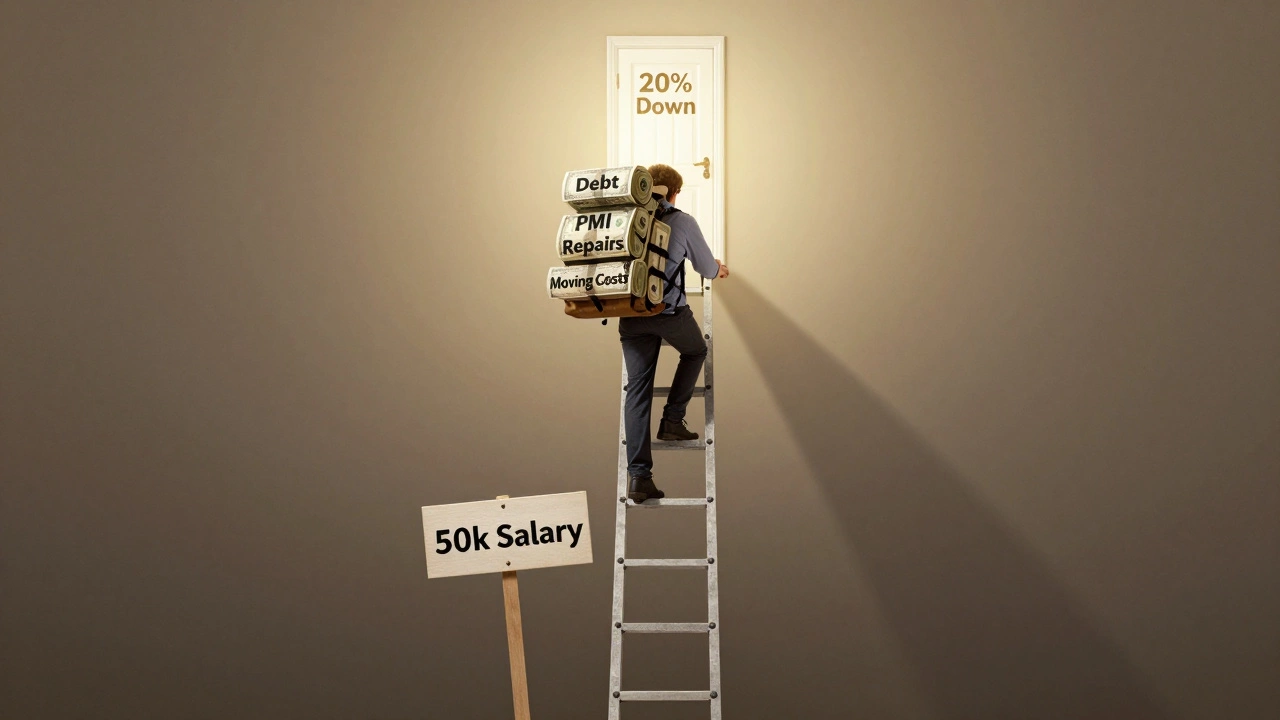
If you’re buying a $250k house, you need at least $35,000 in cash-not just for the down payment, but for everything else. That’s not $5k. That’s not $10k. That’s $35k.
Is It Worth It?
If you can make it work-low debt, high credit, strong savings, and a low-cost area-then yes. Owning a home builds equity, locks in your housing cost, and gives you stability.
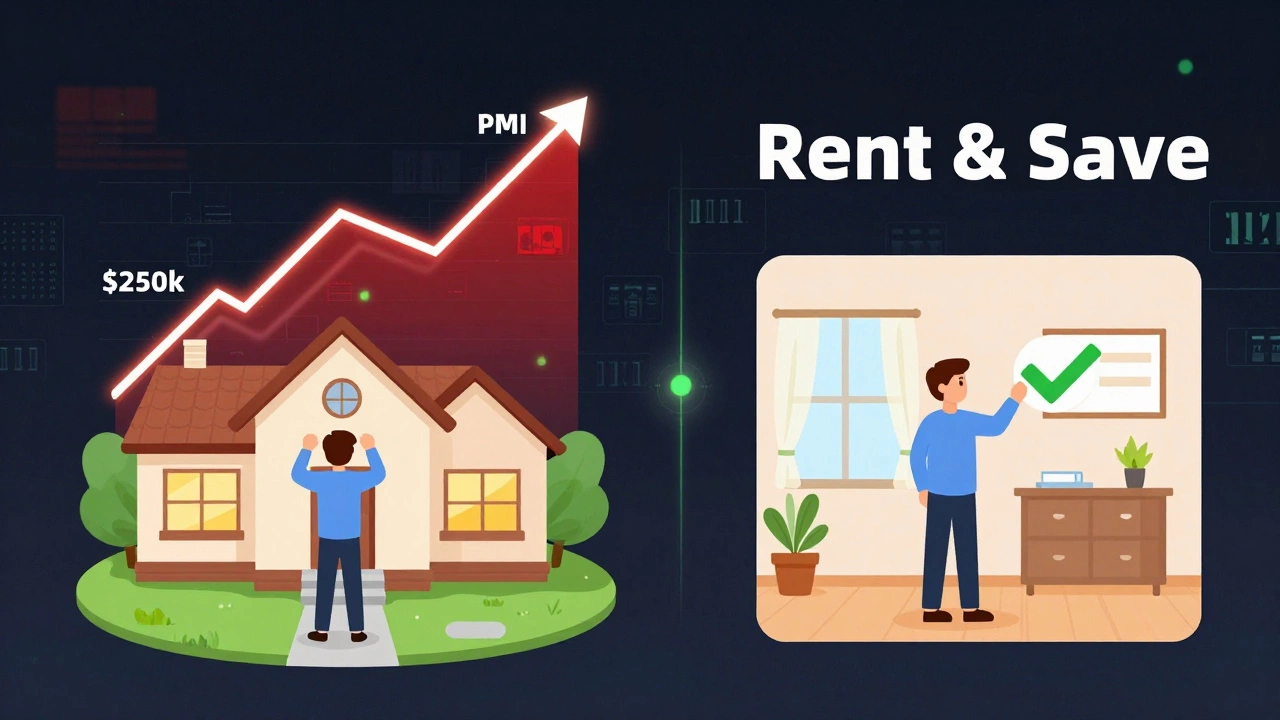
But if you’re stretching so thin that you can’t afford a flat tire or a doctor’s visit? Then no. Renting isn’t throwing money away. It’s keeping your options open.
There’s no rush. The housing market won’t disappear. Interest rates will drop again. Your income might rise. Your credit score will improve. Waiting two years might mean buying a better home for less money.
Don’t chase a number. Chase stability.