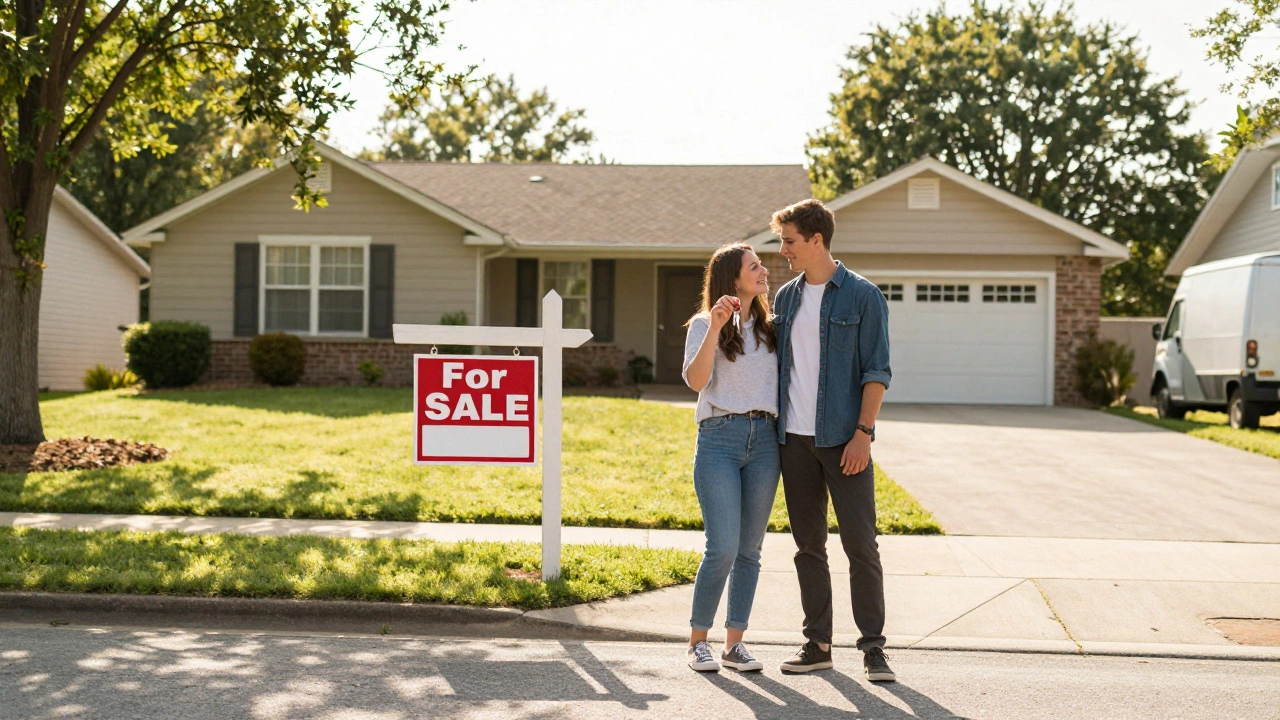
Home Affordability Calculator
How Much House Can You Afford?
Calculate your maximum home price with $10,000 down payment based on your financial situation
Your Affordable Home Price
$With $10,000 saved for a down payment, you might be wondering: how much house can I actually afford? It’s a question every first-time buyer asks, and the answer isn’t as simple as multiplying your down payment by ten. Lenders don’t just look at your down payment-they look at your income, debt, credit score, and where you’re buying. Let’s break it down, step by step, so you know exactly what’s possible.
What $10,000 Can Buy You Right Now
In 2026, the median home price in the U.S. is around $420,000. A 20% down payment on that would be $84,000. But you’re not putting down 20%. You’re putting down $10,000. That’s about 2.4% of the median price. So right off the bat, you’re not looking at a $400,000 home. You’re looking at something closer to $250,000-$300,000, depending on your loan type and location.
Here’s the math: if you put $10,000 down, and your lender allows a 96.5% loan-to-value ratio (which is common with FHA loans), you can borrow up to $235,000. That means the maximum home price you can target is $245,000. That’s not a mansion. But in many parts of the country, it’s still a perfectly livable home-a three-bedroom ranch, a townhouse, or a small single-family house in a growing suburb.
Your Debt-to-Income Ratio Matters More Than You Think
Let’s say you found a $240,000 home. You’ve got your $10,000 down. Great. But lenders don’t just care about your down payment. They care about your debt-to-income ratio (DTI). This is the percentage of your monthly income that goes toward debt payments, including your mortgage, car loans, student loans, and credit card minimums.
FHA loans, which are popular with first-time buyers, allow a DTI up to 50%. But that doesn’t mean you should stretch that far. A safer target is 36% or lower. Let’s say you make $55,000 a year. That’s about $4,583 per month. At 36% DTI, your total monthly debt payments can’t exceed $1,650.
Your mortgage payment includes principal, interest, taxes, and insurance (PITI). For a $240,000 home with a 30-year FHA loan at 6.5% interest, your monthly payment would be around $1,500. Add $300 for property taxes and $100 for homeowners insurance, and you’re at $1,900. That’s already over your safe limit. You’d need to find a cheaper home, or increase your income.
Location Changes Everything
One $240,000 home in Ohio might be a three-bedroom house with a yard. The same price in California might be a 600-square-foot studio in a city with no parking. That’s why location is the biggest factor in what $10,000 can buy you.
In places like:
- Wichita, KS - $200,000 gets you a 1,800 sq ft home
- Cincinnati, OH - $220,000 gets you a 3-bedroom, 2-bath house
- Albuquerque, NM - $230,000 includes a garage and fenced yard
- Phoenix, AZ - $250,000 gets you a newer build in a family-friendly neighborhood
But in cities like San Francisco, Seattle, or New York, $250,000 might buy you a parking spot next to a studio apartment. If you’re set on buying in a high-cost area, you’ll need to look at smaller units, condos, or even co-ops. Or consider moving to a nearby suburb where prices are lower.
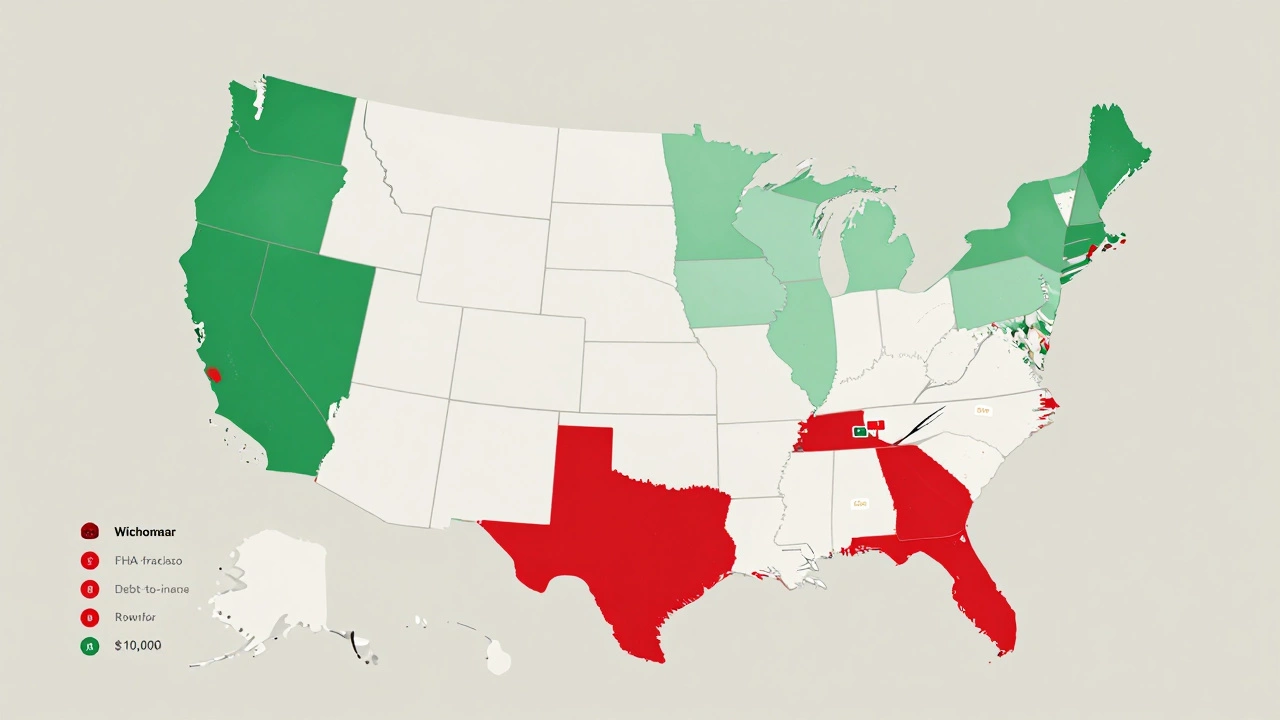
Loan Types That Work With ,000 Down
Not all loans are created equal. Your down payment size limits your options.
- FHA loans: Require as little as 3.5% down. With $10,000, you can buy up to $285,000. But you’ll pay mortgage insurance for at least 11 years. This is the most common path for first-timers with limited savings.
- VA loans: If you’re a veteran or active-duty service member, you can buy with $0 down. Your $10,000 could go toward closing costs or a bigger home.
- USDA loans: Available in rural and some suburban areas. Also $0 down. Your $10,000 can help reduce monthly payments or upgrade finishes.
- Conventional loans: Require at least 3% down. That means you can technically buy a $333,000 home. But you’ll need excellent credit (700+) and a DTI under 45%. Private mortgage insurance (PMI) kicks in until you hit 20% equity.
Most people with $10,000 down go with FHA. It’s forgiving. But it’s not free. You’ll pay an upfront mortgage insurance premium (about 1.75% of the loan) and ongoing monthly premiums. That adds $100-$200 to your payment every month.
Hidden Costs You Can’t Ignore
That $10,000 isn’t just for the down payment. It’s also for:
- Closing costs: Typically 2%-5% of the home price. On a $240,000 home, that’s $4,800-$12,000. You might need to ask the seller to cover part of it.
- Inspections: $300-$700 for home, pest, and sewer checks.
- Appraisal: $400-$600. The lender requires this.
- Move-in costs: Security deposits for utilities, furniture, cleaning, and maybe a new washer/dryer.
If you spend your entire $10,000 on the down payment, you might not have enough left to move in. That’s why many buyers with $10,000 aim for homes priced around $200,000-$220,000. That leaves $2,000-$4,000 for closing and move-in costs.

Can You Afford It Beyond the Mortgage?
Just because you can get approved for a $240,000 home doesn’t mean you should. Look at your entire budget.
Let’s say you make $50,000 a year. After taxes, you take home about $3,200/month. Your rent is currently $1,200. You spend $400 on groceries, $200 on gas, $150 on phone and internet, $300 on dining and entertainment, and $200 on miscellaneous. That’s $2,450. You’ve got $750 left.
Your mortgage payment? $1,500. That’s more than your entire leftover cash. You’d be living paycheck to paycheck. No emergency fund. No car repairs. No vacation. That’s not sustainable.
Real affordability means you still have breathing room. Aim for a mortgage payment that’s no more than 25% of your take-home pay. That means if you make $50,000 a year, your mortgage should be under $1,000/month. That’s a home priced around $180,000 with a 30-year FHA loan.
What You Can Do Right Now
Don’t just start house hunting. Do this first:
- Check your credit score. Aim for at least 640 for FHA. If it’s below 600, focus on improving it for 3-6 months.
- Get pre-approved. Don’t get pre-qualified-get pre-approved. That means a lender has reviewed your bank statements, pay stubs, and tax returns.
- Use a home affordability calculator. Try the ones from NerdWallet or Zillow. Plug in your income, debt, and down payment.
- Look at homes in lower-cost areas. Don’t limit yourself to your current city.
- Consider new construction. Builders often offer incentives like closing cost help or rate buydowns.
With $10,000 down, you’re not buying luxury. You’re buying stability. You’re buying a place to call your own. It’s not about how big the house is-it’s about whether you can live in it without stress.
Final Reality Check
If you have $10,000 saved and nothing else, you’re probably looking at a home between $180,000 and $240,000. You’ll need a credit score above 640, steady income, and low debt. You’ll pay mortgage insurance. You’ll need to save extra for closing and move-in costs. And you’ll need to live in a market where that price range still buys you a real home.
It’s possible. But it’s not easy. And it’s not the same everywhere. If you’re willing to relocate, compromise on square footage, or wait a few more months to save a little more, you’ll have a much better shot.
Don’t rush. Don’t overpay. Don’t stretch so thin you lose sleep. The goal isn’t to own a house-it’s to own a house you can live in for years without regret.
Can I buy a house with $10,000 down and bad credit?
It’s very difficult. Most lenders require a minimum credit score of 620-640 for FHA loans. If your score is below 600, you’ll likely be denied. Your best move is to spend 6-12 months improving your credit: pay down credit cards, fix errors on your report, and make all payments on time. Even a 50-point boost can open up better loan options.
Do I need to save more than $10,000?
Yes, ideally. $10,000 covers the down payment, but you’ll also need $4,000-$8,000 for closing costs, inspections, and move-in expenses. If you spend all your savings on the down payment, you won’t have an emergency fund. Aim for $15,000 total if possible-$10,000 for down, $5,000 for everything else.
Can I use gift money for my down payment?
Yes, FHA and conventional loans allow gift money from family members. You’ll need a gift letter stating the money is not a loan, and the donor must show proof they have the funds (bank statement). You can’t use gift money for closing costs on conventional loans, but you can on FHA loans.
What if I can’t find a home under $250,000 in my area?
You have three options: 1) Look in nearby towns or suburbs-prices drop quickly just 10-15 miles out. 2) Consider a condo or townhouse-they’re cheaper than single-family homes. 3) Wait and save more. Many first-time buyers wait 6-18 months to increase their down payment. It’s better than getting stuck with a house you can’t afford.
Is it better to wait and save more, or buy now?
If home prices in your area are rising fast, buying now with $10,000 might make sense. But if you’re already stretched thin on your budget, waiting 6-12 months to save an extra $5,000 could mean a bigger home, lower monthly payments, and less stress. Ask yourself: will I still be comfortable in this home in three years? If the answer is no, wait.