
Auckland Home Affordability Calculator
Affordability Calculator
Calculate your home buying potential in Auckland based on your income and savings
Key Findings
Enter your income and savings to see your affordability
You’re making $40,000 a year. You’ve saved a little. You’ve stared at Zillow for hours. You keep asking yourself: Can I afford a house on $40k a year in Auckland? The short answer is yes-but only if you know where to look, what to skip, and how to stretch every dollar. This isn’t about luxury. It’s about survival. And survival in Auckland’s housing market means playing smart, not hard.
What $40k a Year Really Buys You
Before you start dreaming about a three-bedroom bungalow, let’s talk numbers. $40,000 a year is $3,333 a month before tax. After KiwiSaver, ACC, and income tax, you’re looking at about $2,800 take-home pay. That’s not much. But it’s enough-if you’re disciplined.
Here’s the reality: the average house price in Auckland is around $1.1 million. Even a modest starter home in Papakura or Manukau sits at $750,000. You won’t be buying that on $40k. But you don’t need to. You need to think smaller. Think older. Think further out.
Let’s say you save $10,000 over two years. That’s your deposit. Most lenders require at least 10% for first-time buyers under the HomeStart grant. That means you can target homes under $100,000. Wait-what?
Yes. $100,000 homes exist. Not in Ponsonby. Not in Remuera. But in places like Waiuku, Pukekohe, or even rural parts of Franklin. These aren’t fixer-uppers in the Hollywood sense. They’re solid, 1970s brick-and-tile homes with a backyard, a garage, and a roof that doesn’t leak. They’re not glamorous. But they’re yours.
Can You Get a Mortgage on $40k?
Banks don’t just look at your salary. They look at your debt, your spending, your savings, and your future. If you’re making $40k and have no credit card debt, no car payments, and no student loans, you’re in a better spot than most.
Most lenders use a rule of thumb: your mortgage repayments shouldn’t exceed 30% of your take-home pay. That’s $840 a month. At current interest rates (around 7.5%), that buys you a loan of roughly $120,000. Add your $10,000 deposit, and you can afford a $130,000 home.
That’s not enough for the city. But it’s enough for the outer suburbs. And here’s the kicker: the HomeStart grant gives first-time buyers up to $5,000 for a deposit if you’re earning under $85k (individual) or $130k (couple). You qualify. Use it.
Also, the KiwiBuild program still has limited stock in areas like Papakura and Manurewa. These homes are priced under $600,000 and come with lower deposit requirements. You might not get your dream home, but you get a home with a title deed-and that’s the win.
Where to Look: The Real Affordable Zones
Forget the suburbs with the fancy cafes and tree-lined streets. You need to look where the prices are low and the transport is decent. Here are three realistic options:
- Pukekohe - 30 minutes from central Auckland. Average house price: $620,000. A small 2-bedroom home can be found for $550,000 if you’re patient. Train access is improving.
- Waiuku - 40 minutes out. Average price: $580,000. You’ll find 1980s homes on 400m² sections. Some have sea views. You’ll need a car, but the land value is solid.
- Helensville - 45 minutes northwest. Prices hover around $550,000. Good schools, quiet streets, and a growing community. Perfect if you work remotely or commute by bus.
These aren’t hot markets. They’re not trending on Instagram. But they’re where people who make $40k live. And they’re the only places where you can get a mortgage approved without a trust fund.

What You Must Skip
Don’t fall for the traps. Here’s what you absolutely must avoid:
- Buying in the city center - Even a studio apartment in Mt Eden costs $500,000. You can’t afford it. Don’t try.
- Overextending on renovations - That $500,000 house with peeling paint? It might need $100,000 in fixes. That’s not a bargain. That’s a financial trap.
- Buying with a partner who has debt - If your partner has $20k in student loans, your borrowing power drops fast. Lenders see combined debt, not combined income.
- Ignoring rates and insurance - Property tax (council rates) in Auckland averages $4,000/year. Insurance is another $1,200. That’s $500 a month. Add it to your mortgage.
One person I know bought a $520,000 home in Papakura thinking it was a steal. Two years later, she’s still fixing the leaking roof, the cracked driveway, and the faulty heating. She’s working two jobs. She’s not living in her home-she’s repairing it.
How to Stretch Your Dollars
You need to treat your money like a resource, not an allowance. Here’s how:
- Use the HomeStart grant - Apply early. It’s not automatic. You need to prove you’ve saved for 6+ months.
- Join KiwiSaver - If you’re not in it, get in. The government gives you $521 a year just for contributing $1,042. That’s free money.
- Buy a section and build later - A $300,000 section in Waiuku is cheaper than a $500,000 house. You can build a small, efficient home over time. Start with one bedroom, add later.
- Live with a flatmate - Even one person paying $250 a week in rent helps. That’s $13,000 a year toward your mortgage or savings.
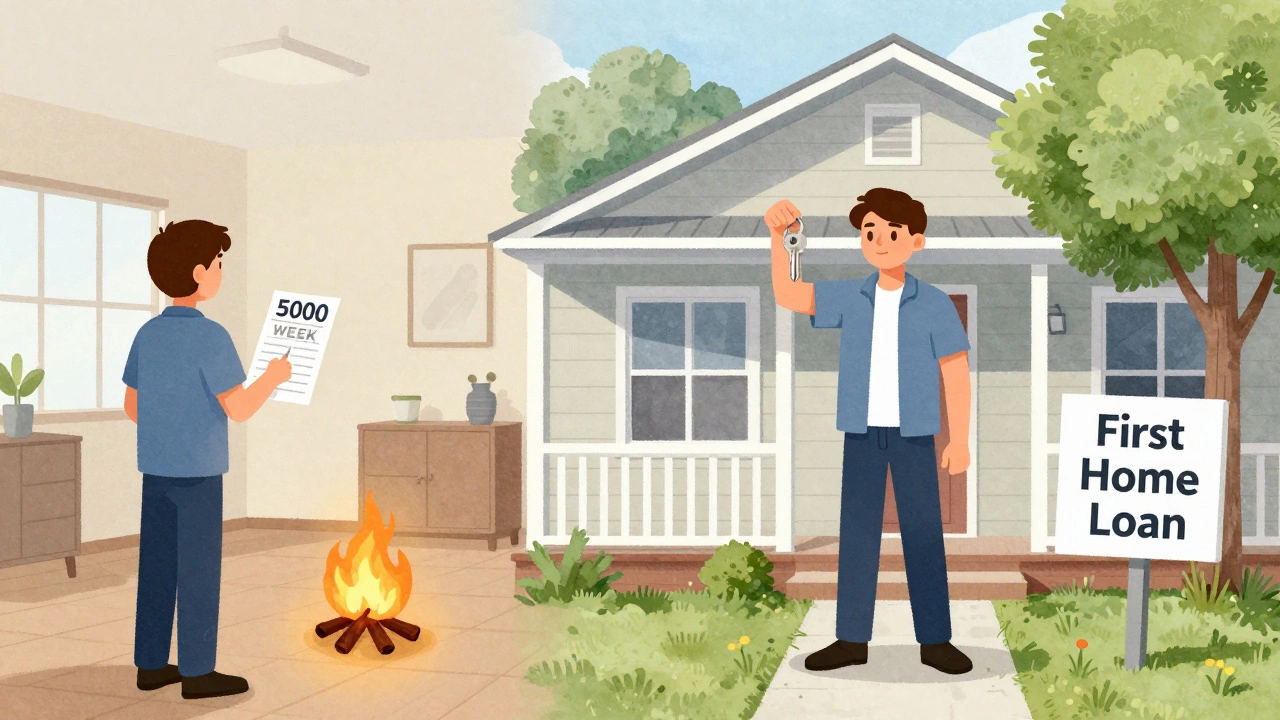
- Use the First Home Loan - If your income is under $95k (individual), you can borrow up to 90% of the property value. No deposit needed if you meet the criteria.
One guy I spoke to bought a $480,000 home in Papakura with $0 deposit. He used the First Home Loan, got the HomeStart grant, and saved $10,000 in the 18 months before applying. He’s now paying $1,050 a month. He works in logistics. He’s 29. He has a dog. He’s happy.
The Real Question: Is It Worth It?
Here’s the truth: renting $500 a week in Auckland means you’re throwing away $26,000 a year. You’re not building equity. You’re not getting tax breaks. You’re not owning anything.
Buying a $550,000 home on $40k a year means you’re paying $1,100 a month. After five years, you’ve paid off $50,000 in principal. You’ve got equity. You’ve got stability. You’ve got a future.
It’s not easy. It’s not glamorous. But it’s possible. And it’s better than renting forever.
What to Do Next
If you’re serious, here’s your 30-day plan:
- Check your credit score (free on Credit Simple or Equifax).
- Calculate your monthly expenses. Cut everything non-essential.
- Open a separate savings account. Automate $300 a week into it.
- Apply for KiwiSaver if you’re not in it.
- Visit the Housing New Zealand website. Check eligibility for HomeStart and First Home Loan.
- Drive to Pukekohe, Waiuku, and Helensville. Look at listings on Trade Me Property.
- Book a free consultation with a mortgage advisor who specializes in first-time buyers.
You don’t need a miracle. You need a plan. And you don’t need to be rich. You just need to be ready.
Can I buy a house in Auckland on $40k a year?
Yes, but not in the city center. You need to look in outer suburbs like Pukekohe, Waiuku, or Helensville where homes start around $550,000. With a $10,000 deposit, the HomeStart grant, and the First Home Loan, it’s possible. Your monthly repayments will be tight-around $1,100-but doable if you have no other debt.
How much deposit do I need for a house on $40k?
Ideally, you need at least 10%-so $55,000 for a $550,000 home. But with the First Home Loan, you can buy with 5% down. And if you qualify for the HomeStart grant, you can get up to $5,000 added to your deposit. Saving $10,000 over two years is realistic if you cut back on eating out, subscriptions, and car payments.
Is renting cheaper than buying on $40k?
No. Renting $500 a week is $26,000 a year with nothing to show for it. Buying a $550,000 home with a $1,100 mortgage means you’re building equity. After five years, you’ll own $50,000+ in property. That’s not just savings-it’s wealth. Renting keeps you poor. Buying gives you a future.
What’s the fastest way to save for a deposit?
Automate savings. Put $300 a week into a separate account. Use the HomeStart grant. Join KiwiSaver to get the $521 government kick-in. Live with a flatmate to split rent. Cut phone plans, streaming services, and daily coffee runs. Save $10,000 in two years is hard-but not impossible.
Can I buy a house with bad credit on $40k?
It’s very difficult. Banks look at your credit score, not just your income. If you have missed payments or defaults, you’ll need to fix them first. Pay off small debts. Get a secured credit card. Rebuild your score over 6-12 months. Then apply. Don’t rush. Bad credit will cost you more in interest than any house ever will.