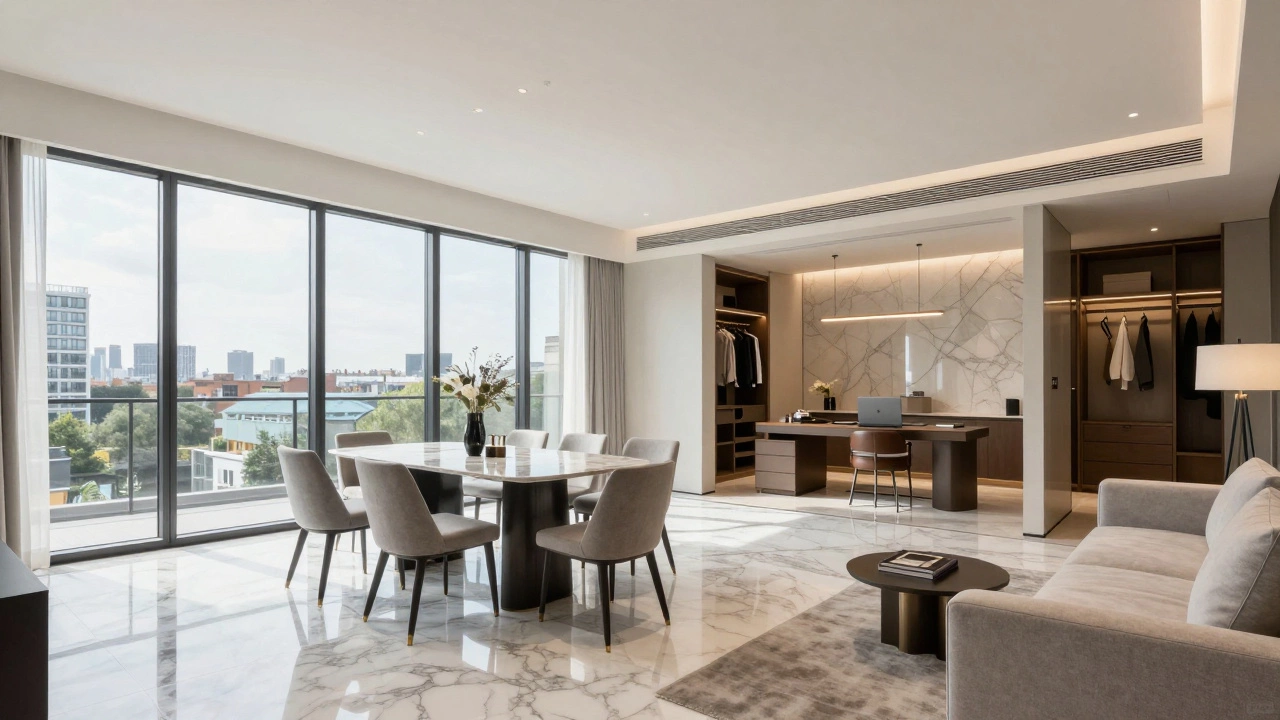
When you hear "luxury apartment," you probably picture marble floors, floor-to-ceiling windows, and a private elevator. But here’s the question no one asks: how big is it actually? Not the view. Not the finishes. The square footage. The real, walkable, live-in space.
There’s no single answer. A luxury apartment in Manhattan isn’t the same as one in Auckland, Sydney, or Dubai. But there are clear patterns - and surprises - if you know where to look.
What’s the minimum size for "luxury"?
Forget what you see in movies. A luxury apartment doesn’t start at 500 square feet. That’s a studio with a view. In most major global markets, the entry point for true luxury is 1,200 square feet (about 111 square meters). Below that, even with gold-plated faucets, it’s still just a high-end studio or one-bedroom. True luxury begins when you have room to breathe - space for a dining area that’s not just a table shoved next to the couch, space for a proper home office that doesn’t feel like a closet, and enough room for guests without feeling cramped.
In Auckland, where luxury living is growing fast, developers are pushing new projects with minimums of 1,100-1,300 sq ft. But in London or New York, where land is scarcer and prices are higher, luxury starts at 1,400 sq ft and often climbs to 1,800+. In Dubai, it’s not unusual to see luxury apartments starting at 2,000 sq ft - and going up from there.
How size breaks down: bedrooms, living, and more
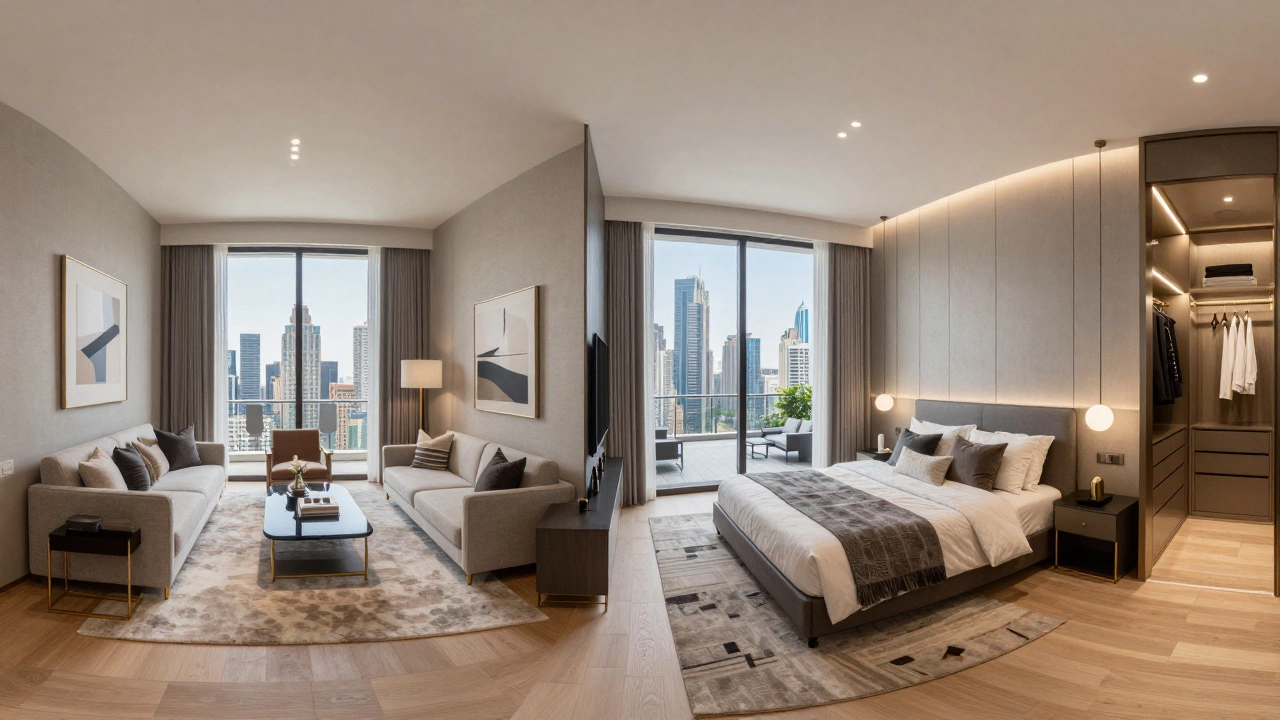
Size isn’t just about the total number. It’s about how it’s used. A 1,500 sq ft luxury apartment in Singapore might have two bedrooms, a study nook, a formal dining area, and a large open-plan kitchen-living zone. In contrast, a 1,500 sq ft unit in Miami might be one massive great room with a separate bedroom wing, no formal dining, and a wraparound terrace.
Here’s what you typically get in a true luxury apartment:
- Two bedrooms minimum - and they’re not tiny. Master bedrooms are usually 200-300 sq ft. The second bedroom is often large enough to double as a home office or guest suite.
- Open-plan living area - at least 500-700 sq ft of combined kitchen, living, and dining space. No walls. No compromises.
- Separate dining zone - not a breakfast bar. A table that seats six comfortably, with room to move chairs.
- Walk-in closet - in the master, not a closet. A dedicated room, often 80-120 sq ft, with built-ins and lighting.
- Private outdoor space - balcony, terrace, or rooftop garden. Minimum 100 sq ft. In cities like Sydney or Vancouver, this can be 200-400 sq ft.
- Additional space - a study, a butler’s pantry, a laundry room, or even a small gym. These aren’t optional extras. They’re standard.
Some luxury buildings even include a dedicated storage unit - separate from the apartment - for seasonal items, luggage, or equipment. That’s not a perk. It’s part of the floor plan.
Why size matters more than finishes
You can upgrade a faucet. You can’t upgrade square footage. That’s why smart buyers focus on layout before marble.
A 1,300 sq ft apartment with a weird, wasted hallway might feel smaller than a 1,100 sq ft unit with a smart, open layout. In luxury markets, developers are learning this. The best new buildings cut out wasted space - no more long corridors, no dead corners. Every inch has a purpose.
Take the new One Tamaki development in Auckland. Their luxury units average 1,450 sq ft. But what makes them stand out isn’t the imported Italian tiles - it’s the 30% more usable space than older luxury towers. No wasted elevator lobbies. No narrow hallways. Just clean, flowing rooms that feel bigger than their numbers suggest.
What you won’t find in luxury apartments
There are limits. Even in the most exclusive buildings, you won’t find:
- Three-car garages - parking is usually one or two spaces, often underground. You don’t need a garage. You need valet.
- Backyards - luxury apartments are vertical. Landscaping is on rooftops or balconies.
- Basements - unless it’s a penthouse with a private wine cellar, basements are rare. They’re expensive to build and harder to ventilate.
- Attics - they’re not practical in high-rises. Storage is handled by dedicated units or concierge services.
And don’t expect a home theater. That’s a luxury add-on, not a standard. Most luxury apartments offer soundproofing, not projection screens. If you want a theater, you’ll need to build it - and pay for the wiring, seating, and acoustics yourself.
Global comparisons: size across cities
Size varies wildly by city - and for good reason. Here’s how luxury apartment sizes stack up in 2026:
| City | Average Size (sq ft) | Average Size (sq m) | Typical Layout |
|---|---|---|---|
| New York City | 1,800 | 167 | 2 bedrooms, 2.5 baths, separate dining, home office |
| London | 1,750 | 163 | 2 bedrooms, study, kitchen-diner, private balcony |
| Dubai | 2,200 | 204 | 2-3 bedrooms, walk-in closets, maid’s room, large terrace |
| Singapore | 1,500 | 139 | 2 bedrooms, study, open-plan living, pantry |
| Auckland | 1,400 | 130 | 2 bedrooms, open kitchen-living, balcony, storage unit |
| Sydney | 1,600 | 149 | 2 bedrooms, terrace, walk-in closet, butler’s pantry |
Notice the pattern? Cities with more land (like Dubai) offer more space. Cities with tight zoning (like New York and London) focus on efficiency. Auckland sits in the middle - growing fast, but still practical.
What luxury really means: space as status
Luxury isn’t about gold taps. It’s about control. Control over your environment. Control over your time. And control over how much space you occupy.
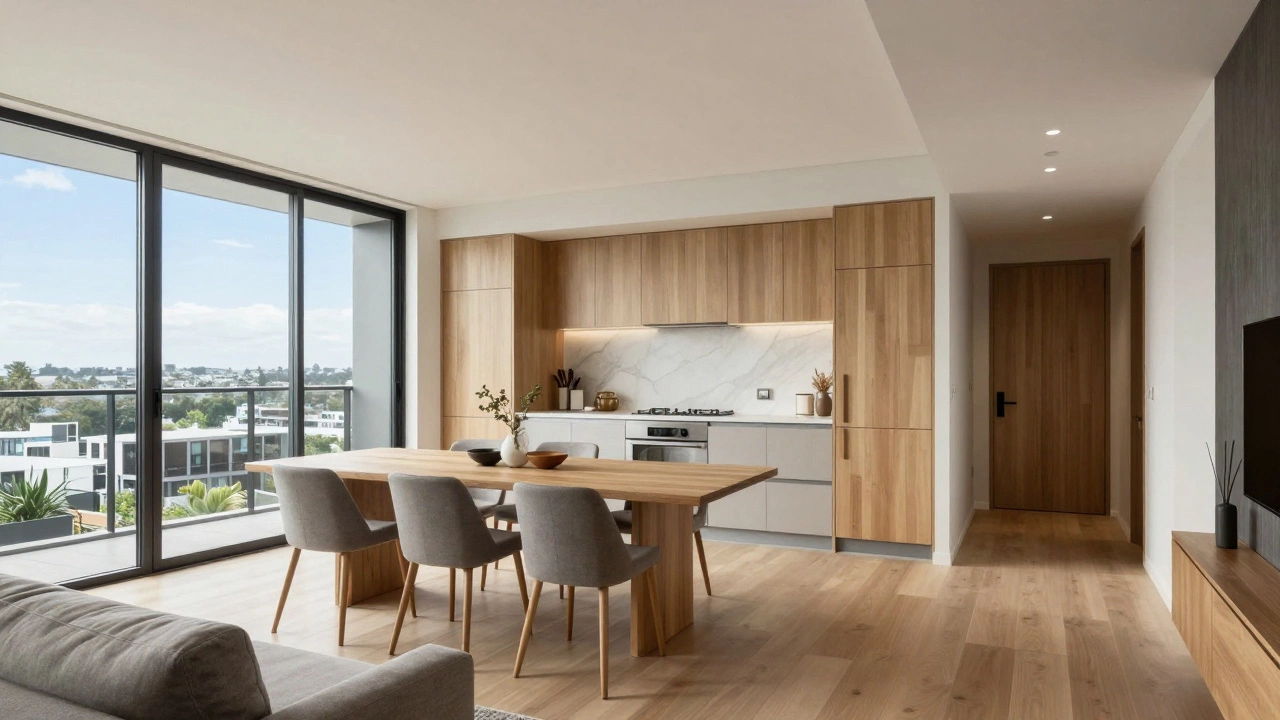
When you live in a 1,800 sq ft apartment, you don’t need to choose between working from home and entertaining. You can do both. You can have a quiet corner for reading, a bright kitchen for morning coffee, and a living area that feels like a gallery - not a showroom.
That’s why the most expensive luxury apartments aren’t always the ones with the best views. They’re the ones with the most usable, well-designed space. The ones where every room has a function, every window has light, and every hallway disappears into openness.
Size doesn’t guarantee luxury. But without enough space, luxury feels like a costume. And in 2026, no one wants to wear one.
How to tell if you’re getting real luxury
Here’s a quick checklist to avoid being sold a pretty package:
- Ask for the net internal area - not the gross area. Developers often include balcony space or walls in their numbers.
- Walk through the floor plan. Can you fit a full-size sofa? A dining table? A desk? If not, it’s not big enough.
- Check if the master bedroom has room for a dresser, nightstands, and a walk-in closet - without feeling crowded.
- Ask if there’s a dedicated storage unit. If not, it’s a red flag.
- Compare the layout to at least two other units. The best luxury spaces feel like they were designed for people, not brochures.
Don’t let finishes fool you. A marble countertop won’t make a 900 sq ft apartment feel spacious. But a smart layout with 1,300 sq ft? That changes how you live.
What is the minimum size for a luxury apartment?
The minimum size for a true luxury apartment is generally 1,200 square feet (111 square meters). Below this, even with high-end finishes, it’s considered a premium or upscale unit - not luxury. Luxury begins when you have room for two bedrooms, a separate dining area, a walk-in closet, and an open-plan living space without feeling cramped.
Is a 1,000 sq ft apartment considered luxury?
Not in most markets. A 1,000 sq ft apartment can be beautifully finished with designer materials, but it’s typically a high-end one-bedroom or studio. True luxury requires space - at least 1,200 sq ft - to accommodate multiple living zones, storage, and comfort without compromise. In cities like New York or London, 1,000 sq ft is considered small even for a standard apartment.
Do luxury apartments always have two bedrooms?
Almost always. While a few ultra-premium studios exist in places like Tokyo or Monaco, the global standard for luxury is two bedrooms. The master bedroom is typically 200-300 sq ft, and the second bedroom is large enough to function as a home office, nursery, or guest suite. A single-bedroom luxury unit is rare and usually marketed as a "studio penthouse" with premium extras.
How does luxury apartment size vary by city?
Size varies significantly. In New York and London, luxury starts around 1,750-1,800 sq ft due to high land costs and dense zoning. In Dubai, where land is more available, luxury apartments average 2,200 sq ft or more. Auckland and Sydney fall in the middle at 1,400-1,600 sq ft. Cities with stricter building codes or smaller plots prioritize smart layouts over raw square footage.
Are balconies included in luxury apartment size?
No, balconies and outdoor areas are usually listed separately as "additional space" and are not counted in the net internal area. Developers sometimes include them in marketing numbers to make the unit seem larger. Always ask for the net internal floor area - this is the usable living space inside the unit, measured from wall to wall.