
Shared Ownership Equity Calculator
Home Value Calculator
Your Equity Results
Your Current Equity Value:
$0
Government's Current Stake:
$0
Your equity has grown from your initial investment. This value represents the percentage of the current property value you own.
Cost to Buy Full Ownership (Staircasing):
$0
Estimated Proceeds After Sale (After Fees):
$0
If you're considering shared ownership, you might wonder how equity holders get paid. The truth? They don't receive regular payments. Instead, their equity is tied to the property's value. Let's break it down.
What's really happening with equity in shared ownership?
shared ownership isn't about getting cash payments. In a system where you own part of a property while another entity (like a government agency) owns the rest, your equity is simply the portion you control. In New Zealand, the First Home Shared Equity Scheme a government program where the government owns up to 25% of a home, and buyers own the rest without paying rent on the government's share works differently than UK models. You don't get rent from the government, and you don't receive monthly payouts. Your equity grows as property values rise, but you only access it when selling.
How shared ownership works in New Zealand
In New Zealand, the First Home Shared Equity Scheme helps first-time buyers enter the market. Here's the reality: you buy 75% of a home's value upfront, and the government owns the remaining 25%. Unlike the UK where you pay rent on the non-owned portion, New Zealand government doesn't charge rent on their stake. Instead, when you sell the property, they take their percentage of the sale price. For example, if you sell a $800,000 home, the government gets $200,000, and you keep $600,000 minus fees. This means your "equity" is locked in the property until you sell.
Building equity over time
Your equity grows as property values increase. Let's say you bought a $600,000 home with a 25% government stake. You paid $450,000 (75%), and the government put in $150,000. Three years later, the home is worth $700,000. Your 75% share is now $525,000, and the government's 25% is $175,000. This growth isn't cash in your pocket-it's value tied to the property. If you sell, you realize this gain. If you stay, your equity keeps growing with the market.
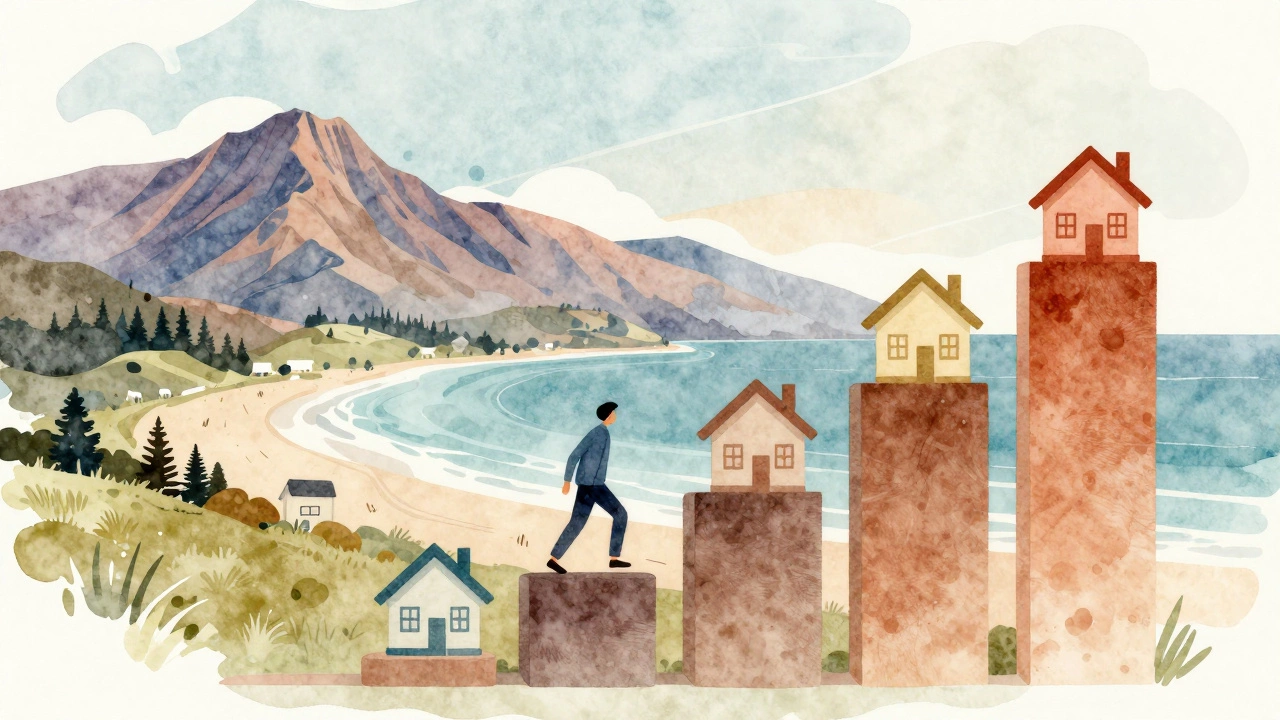
Staircasing: Buying more equity
You can increase your ownership stake through staircasing the process of buying additional shares from the government over time. In New Zealand's scheme, you can purchase more of the government's share. For example, if you want full ownership, you'd buy the remaining 25% at current market value. If the home is now worth $700,000, the government's 25% stake costs $175,000. Paying this amount means you own 100% of the property. After staircasing, you no longer have to deal with government involvement in future sales.
Selling your home
When you sell, the proceeds split based on ownership percentages. Let's say you sell a home for $850,000. If the government owns 25%, they receive $212,500. You get $637,500 minus selling costs like real estate fees (typically 2-3% of sale price) and legal fees. In Auckland, where property values are high, this can mean significant returns. For instance, a buyer who purchased a $750,000 apartment in 2023 with 75% ownership saw their share grow to $637,500 after selling in 2026. This shows how equity builds through market appreciation.

Common myths about shared ownership equity
- Myth: "You get rent from the government." Reality: In New Zealand's scheme, there's no rent on the government's share. Their stake is repaid via sale proceeds.
- Myth: "Equity is like a dividend." Reality: Equity isn't cash flow-it's the value of your ownership stake. You can't access it until selling.
- Myth: "You can sell anytime." Reality: Schemes often have restrictions. In NZ, you may need to wait a set period before selling or follow specific processes.
Real example from Auckland
Sarah, a first-time buyer in Auckland, used the First Home Shared Equity Scheme to purchase a $750,000 apartment. She paid $562,500 (75%), and the government owned 25%. Three years later, the apartment was worth $850,000. When she sold it, the government received $212,500 (25%), and Sarah got $637,500 minus $15,000 in fees. Her initial $562,500 investment grew to $622,500 after fees-demonstrating how equity builds through property value increases.
Frequently Asked Questions
Do I pay rent on the government's share in New Zealand's shared ownership scheme?
No. Unlike the UK model, New Zealand's First Home Shared Equity Scheme doesn't charge rent on the government's stake. The government's portion is repaid as a percentage of the sale price when you sell.
Can I buy more equity in my home?
Yes. This is called staircasing. You can purchase additional shares from the government at current market value. For example, if you want full ownership, you'd buy the remaining stake (e.g., 25%) based on today's property valuation.
What happens if the property value drops?
If the property value falls, your equity decreases. For instance, if you bought a $600,000 home and it drops to $500,000, your 75% share is worth $375,000. You still owe the mortgage on your original purchase price, but the value of your equity is lower. This is why property markets matter.
Is shared ownership only for first-time buyers?
In New Zealand, the First Home Shared Equity Scheme is specifically for first-time buyers. However, other shared ownership models may exist for different groups. Always check the specific scheme's eligibility rules.
How does this compare to a regular mortgage?
With a regular mortgage, you own the entire property from day one. With shared ownership, you own a portion and share ownership with another entity. This lowers upfront costs but means you share sale proceeds. It's a trade-off between affordability and full ownership.
What are the risks of shared ownership?
The main risks include: property value drops reducing your equity, limited flexibility in selling (since the government must be paid), and potential complications if you need to sell quickly. Also, if you can't afford to staircase, you'll always have a partner in ownership.