Down Payment Calculator for $100,000 Home
Calculate Your Down Payment
Choose your loan type and see how much you need to save for a $100,000 home.
Your Results
Total Upfront Costs
Buying your first home is exciting-but the down payment can feel like a wall. If you’re looking at a $100,000 house, you might be wondering: How much down payment for a 100K house? The answer isn’t one number. It depends on your loan type, credit score, and where you live. But here’s the good news: you don’t need 20% upfront. Many first-time buyers put down as little as 3%-that’s just $3,000.
What’s the minimum down payment for a $100,000 house?
The lowest down payment you can make on a $100,000 home is $3,000. That’s with an FHA loan, which is designed for first-time buyers with limited savings. FHA loans let you put down 3.5% if your credit score is 580 or higher. If your score is between 500 and 579, you’ll need 10%-$10,000. Most people qualify for the 3.5% option.
VA loans (for veterans and active military) and USDA loans (for rural areas) can let you buy with $0 down. But you have to meet strict eligibility rules. If you’re not eligible, FHA is your best bet for a low down payment.
Conventional loans usually require 5% to 20%. But Fannie Mae’s HomeReady and Freddie Mac’s Home Possible programs allow 3% down for first-time buyers-even if your income is modest. These programs also let you use gift money for the down payment, which helps if your family wants to help you out.
Why do lenders care about down payment size?
Lenders don’t just want your money-they want to reduce their risk. If you put down 3%, you have less skin in the game. That means if the housing market drops, you’re more likely to owe more than your house is worth. That’s called being underwater.
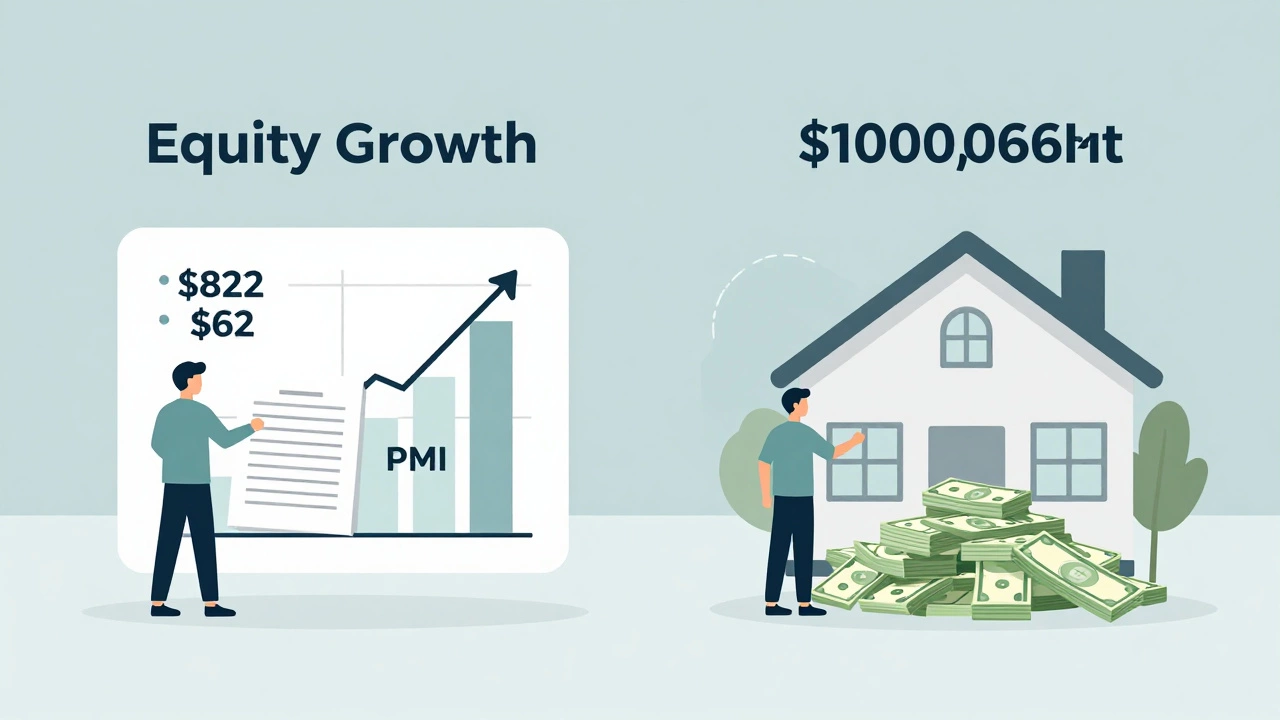
That’s why lower down payments come with strings attached. You’ll almost always pay for private mortgage insurance (PMI) if you put down less than 20%. For a $100,000 home with a 3% down payment, PMI could cost you $30 to $70 a month. That’s extra on top of your mortgage payment.
But here’s the twist: PMI isn’t forever. Once your equity hits 20%, you can request to cancel it. Some lenders automatically drop it when you hit 22% equity. So if you make extra payments or your home value goes up, you’ll get rid of PMI faster than you think.
What’s the real cost of a 3% down payment?
Let’s break it down for a $100,000 home with a 3% down payment ($3,000):
- Mortgage amount: $97,000
- Interest rate (2025 average): 6.5%
- Monthly principal and interest: $612
- PMI (estimated): $50
- Property taxes (avg.): $120
- Home insurance: $40
- Total monthly payment: $822
Compare that to a 20% down payment ($20,000):
- Mortgage amount: $80,000
- Monthly principal and interest: $503
- PMI: $0
- Property taxes: $120
- Home insurance: $40
- Total monthly payment: $663
You’re paying $159 more each month with the 3% option. That’s nearly $2,000 extra per year. But if you can’t save $20,000, the 3% option lets you buy now instead of waiting years.
Can you buy a $100,000 house with no money down?
Yes-but only under specific conditions.
VA loans: If you’re a veteran, active-duty service member, or eligible surviving spouse, you can get a VA loan with $0 down. There’s no PMI, and interest rates are often lower. But you’ll pay a funding fee-usually 2.15% of the loan amount. For a $100,000 loan, that’s $2,150. You can roll that into your loan, so you don’t pay it upfront.
USDA loans: These are for homes in approved rural or suburban areas. The government wants to boost housing in these zones. You can get 100% financing, but the home must be in a qualifying location. Check the USDA eligibility map online. Income limits also apply-your household income can’t exceed 115% of the area median.
State and local programs: Many cities offer down payment assistance. For example, in places like Detroit, Cleveland, or rural Alabama, you might get a $5,000 to $10,000 grant or forgivable loan. These are often paired with FHA or conventional loans. You don’t repay them if you live in the home for 5-10 years.
What if you can’t afford closing costs?
Down payment isn’t the only cost. Closing costs for a $100,000 home run between $2,000 and $5,000. They cover appraisal, title insurance, lender fees, and more.
Here’s how to handle it:
- Ask the seller to pay up to 6% of the purchase price toward your closing costs. This is common in buyer’s markets.
- Roll closing costs into your loan. Some lenders let you do this, but it increases your monthly payment.
- Use a gift from family. FHA and conventional loans allow gifts from relatives. Get a gift letter signed by the giver.
- Look for lender credits. You can accept a slightly higher interest rate in exchange for the lender covering your closing costs.
Don’t assume you need $25,000 saved. Many first-time buyers close with under $10,000 total out of pocket.
How to save for a down payment faster
Want to get to $10,000 in 12 months? That’s $833 a month. Here’s how real people do it:
- Open a separate savings account labeled “House Fund.” Automate transfers every payday.
- Cancel one subscription (streaming, gym, phone plan). Save $30-$50/month.
- Sell unused items on Facebook Marketplace or Poshmark. One weekend of selling can net $500-$1,000.
- Take on a side gig-dog walking, delivery, tutoring. Even $200/month adds up.
- Use a windfall: tax refund, bonus, or birthday money. Put it straight into your house fund.
Some buyers save $5,000 in 6 months by cutting dining out, switching to a cheaper phone plan, and using public transit instead of Uber.
What happens if you put down less than 10%?
Low down payments are allowed-but they come with trade-offs.
- You’ll pay PMI until you hit 20% equity.
- You might get a slightly higher interest rate, especially with lower credit scores.
- Lenders may require a higher credit score for conventional 3% loans than for FHA.
- It’s harder to qualify if your debt-to-income ratio is over 43%.
But if you have steady income, a decent credit score (640+), and you plan to stay in the house for 5+ years, the low down payment makes sense. You’re building equity instead of paying rent.

Is a 0,000 house a good deal?
$100,000 homes are usually in smaller towns, older neighborhoods, or areas with lower demand. That doesn’t mean they’re bad. Many are solid, well-built houses from the 1950s-1980s. The key is inspection.
Watch out for:
- Old plumbing (galvanized pipes or polybutylene)
- Lead paint (homes built before 1978)
- Roof age (over 20 years old = expensive repair)
- Basement water damage or mold
- Outdated electrical (knob-and-tube wiring)
A $400 home inspection is worth it. It could save you $10,000 in repairs.
Also, check the neighborhood. Is the school district improving? Are new businesses opening? A $100,000 house in a growing area can be a smart investment.
Bottom line: You can buy a $100,000 house with very little down
You don’t need $20,000 to buy your first home. With FHA loans, you can put down $3,000. With VA or USDA loans, you might put down $0. Down payment assistance programs can cover even more.
Yes, you’ll pay more each month because of PMI and higher interest. But you’ll also be building equity instead of giving money to a landlord. And once you hit 20% equity, you can drop PMI and lower your payment.
Start by checking your credit score. Get pre-approved. Talk to a HUD-approved housing counselor. They’ll help you find programs you didn’t even know existed.
Waiting to save $20,000 might mean missing your chance. In many places, home prices are rising faster than your savings. Buying now-even with a small down payment-can be the smarter long-term move.
Can I buy a $100,000 house with a credit score of 600?
Yes. FHA loans accept credit scores as low as 500, but you’ll need 10% down if your score is below 580. At 600, you qualify for the 3.5% down payment option. Lenders may require a higher score for conventional loans with 3% down, so FHA is your best bet.
How long does it take to get PMI removed?
You can request PMI removal once you reach 20% equity in your home. That usually takes 5-7 years with normal payments, depending on your loan terms. If your home value increases faster, you can request an appraisal to prove equity sooner. Lenders must cancel PMI automatically when you hit 22% equity.
Are there grants for first-time buyers in 2025?
Yes. Many states and cities offer down payment assistance grants. For example, California’s MyHome Assistance Program, Texas’s HFA, and Ohio’s Homebuyer Program offer $5,000-$15,000 in grants that don’t need to be repaid. These are often paired with FHA or conventional loans. Check your state’s housing finance agency website.
Can I use gift money for the down payment?
Yes. FHA, VA, USDA, and most conventional loans allow gift money from family members. You’ll need a signed gift letter stating the money is not a loan. The giver must prove they can afford to give it. Don’t accept cash gifts without documentation-it can delay or kill your loan approval.
Is a $100,000 house a bad investment?
Not necessarily. Many $100,000 homes are in up-and-coming neighborhoods or areas with low property taxes. If the house is structurally sound and you plan to live there 5+ years, it’s a solid first step. The goal isn’t to flip it-it’s to build equity, stabilize your finances, and move up later. Many people use their first home as a stepping stone.
Next steps if you’re ready to buy
1. Check your credit report at AnnualCreditReport.com. Fix errors if needed.
2. Get pre-approved by at least two lenders. One should specialize in first-time buyer programs.
3. Talk to a HUD-approved housing counselor. They’re free and can help you find grants.
4. Start looking at homes in your budget. Don’t just look at price-look at condition, location, and future value.
5. Don’t wait for the perfect moment. The perfect time to buy is when you’re ready to commit-not when you have every dollar saved.