
Business Valuation Calculator
How Your Business Is Valued
Business value isn't about sales—it's about profit. This calculator estimates your business value based on your seller's discretionary earnings (SDE) and key value drivers.
Value Drivers
Select factors that impact your business value
When a business hits $1 million in annual sales, people start asking: How much is this actually worth? It’s not as simple as saying it’s worth a million. A business isn’t a house where you just look at square footage and location. It’s a mix of cash flow, customer base, systems, team, and future potential. And that’s why two businesses with the same $1 million in sales can be worth wildly different amounts.
It’s not about sales - it’s about profit
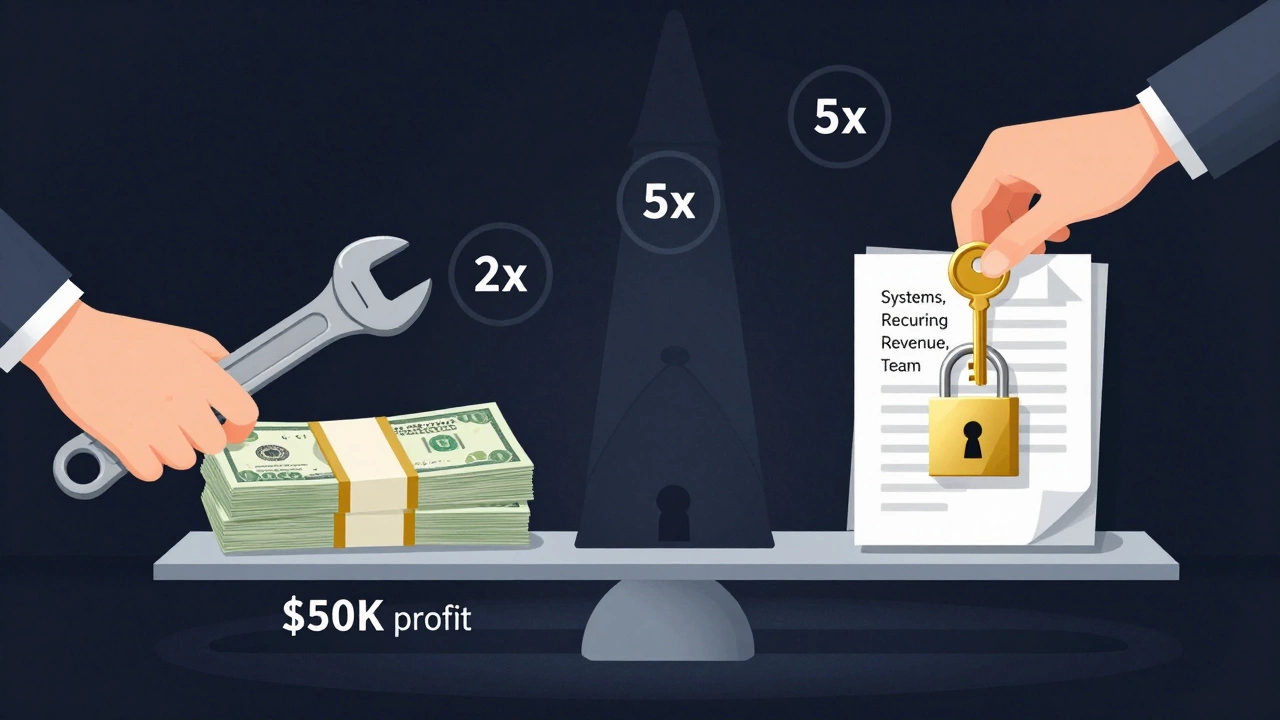
Many people assume that if a business makes $1 million in sales, it’s worth $1 million. That’s a common mistake. Sales are just the top line. What matters is what’s left after you pay for everything - the profit. A business making $1 million in sales but only $50,000 in net profit is in a very different position than one making $1 million in sales and $300,000 in profit.
Take two local businesses in Auckland. One is a small café that serves 1,200 coffee and toast combos a week. It’s busy, but rent, wages, and ingredient costs eat up 90% of revenue. Net profit? $45,000 a year. The other is a specialized plumbing company that charges $150 per job, does 6,700 jobs a year, and has low overhead because it’s run by two owners with one apprentice. Net profit? $280,000. Same sales. Totally different value.
Buyers don’t pay for sales. They pay for profit. And they want to know how long it will take to get their money back. That’s where valuation multiples come in.
Valuation multiples: The real pricing engine
The standard way to value a small business is using a multiple of its earnings - usually EBITDA (Earnings Before Interest, Taxes, Depreciation, and Amortization) or seller’s discretionary earnings (SDE). For businesses under $2 million in sales, SDE is the most common metric used in New Zealand.
Here’s what you’ll typically see in the local market:
- Businesses with $50,000-$100,000 in SDE: 1.5x to 2.5x multiple
- Businesses with $100,000-$200,000 in SDE: 2.5x to 3.5x multiple
- Businesses with $200,000+ in SDE: 3.5x to 5x+ multiple
So if your business has $1 million in sales and $250,000 in SDE, you’re looking at a value between $875,000 and $1.25 million. If your SDE is only $80,000, your business might sell for $200,000-$280,000.
Why the big range? Because multiples depend on risk. A business that relies on one owner to run every client call is risky. A business with trained staff, documented processes, and recurring revenue is worth more.
What makes a business worth more?
Buyers are looking for businesses that can keep running without them. That’s the golden rule. Here’s what adds value:
- Recurring revenue - Customers who pay monthly or annually (like a cleaning service with 50 contracts) are worth more than one-off sales.
- Strong customer base - No single customer making up more than 10% of sales. If 40% of your income comes from one client, the business is fragile.
- Systems and documentation - If you can hand over a 50-page operations manual and the business still runs, you’re in the top 10% of sellers.
- Profit consistency - Three years of steady or growing profits beats one great year followed by two down years.
- Brand and reputation - A business with Google reviews, a loyal following, or a strong local name sells faster and for more.
On the flip side, red flags that slash value: owner dependency, outdated tech, legal disputes, declining sales, or high staff turnover. One Auckland-based landscaping business sold for half its expected price because the owner was the only one who knew how to operate the heavy machinery - and he refused to train anyone else.
Real examples from the New Zealand market
Let’s look at three real cases from last year:
- A digital marketing agency in Wellington with $1.1 million in sales, $220,000 in SDE, 12 employees, and 80% recurring revenue sold for $800,000 (3.6x SDE).
- A retail store in Christchurch with $980,000 in sales, $65,000 in SDE, and no staff beyond the owner sold for $140,000 (2.1x SDE).
- A food delivery service in Auckland with $1.05 million in sales, $310,000 in SDE, automated ordering, and 35 regular clients sold for $1.4 million (4.5x SDE).
Notice how the profit margin and structure made the difference - not the sales number.
What if your business has $1 million in sales but no profit?
It’s not impossible to sell a business that’s not profitable, but it’s rare and risky. Buyers might pay if:
- There’s a clear path to profitability (e.g., you’re in a high-growth niche like solar installation and just need scale)
- You have valuable assets - equipment, patents, or a strong domain name
- You’re selling to a strategic buyer who wants to eliminate competition or grab your customer list
But in most cases, if you’re not making money, your business is a cost center - not an asset. Don’t expect to walk away with cash. You might be better off shutting it down, selling the equipment, and walking away with $20,000 than trying to sell the whole thing for $0.

How to get the best price
If you’re thinking of selling, here’s what actually works:
- Get your books in order - clean, accurate financials are non-negotiable. Buyers will hire an accountant to check them.
- Fix the owner dependency - hire and train someone to take over your role, even if it’s just part-time.
- Document everything - from how you handle complaints to how you order supplies.
- Boost your profit in the 12 months before selling - cut unnecessary costs, raise prices slightly, or drop low-margin clients.
- Work with a business broker who knows the local market. In New Zealand, brokers like Business Broker NZ or Business Exchange have access to serious buyers.
Most sellers think they can sell on their own. They list on Trade Me or Facebook and get three lowball offers. The ones who hire a broker and prep properly often get 30-50% more.
Final reality check
$1 million in sales sounds impressive. But if you’re working 70 hours a week, living off $40,000 a year, and your business collapses the day you leave - it’s not a business. It’s a job with a fancy name.
A real business is something that can run without you. It’s not about how much you bring in. It’s about how much you keep, how predictable it is, and how easily someone else can take over.
If your $1 million in sales turns into $250,000 in profit and you’ve built systems that outlive you, you’re sitting on a business worth close to a million dollars. If it turns into $50,000 in profit and you’re the only one who knows how to do anything? You’re not selling a business. You’re selling a job - and jobs don’t sell for much.
Can a business with $1 million in sales be worth less than $100,000?
Yes, absolutely. If the business has very low profit - say $20,000 net - and depends entirely on the owner to run every operation, it might sell for 2-3 times that profit, which is $40,000-$60,000. Buyers see it as a job, not an asset. Without recurring revenue, systems, or growth potential, the value drops sharply.
Do I need an accountant to value my business?
You don’t need one to get a rough estimate, but you absolutely need one before you sell. Buyers will hire one. If your books are messy or inconsistent, your offer will be slashed or pulled. A good accountant can help you clean up your financials, adjust for owner perks, and show true profitability - which can add hundreds of thousands to your sale price.
Is there a formula to calculate business value?
There’s no single formula, but the most common method is: SDE × Multiple. First, calculate your seller’s discretionary earnings - your net profit plus owner salary, perks, and non-recurring expenses. Then apply a multiple based on your industry, location, and risk. In New Zealand, most small businesses sell between 2x and 4.5x SDE. The higher your profit, stability, and systems, the higher the multiple.
How long does it take to sell a business with $1 million in sales?
On average, it takes 6 to 12 months. Businesses with strong financials, clear documentation, and realistic pricing sell faster - sometimes in 3 to 5 months. Those with owner dependency, unclear books, or overpriced expectations can sit for over a year. The best time to sell is when you’re not desperate.
Should I sell my business or keep it and grow?
If your business is profitable, stable, and you enjoy running it, growing it is often smarter. A business that grows from $1 million to $2 million in sales and $400,000 in profit could double in value. But if you’re burned out, overwhelmed, or want to retire, selling now gives you freedom. Don’t wait until you’re forced to sell - plan it like any other financial goal.