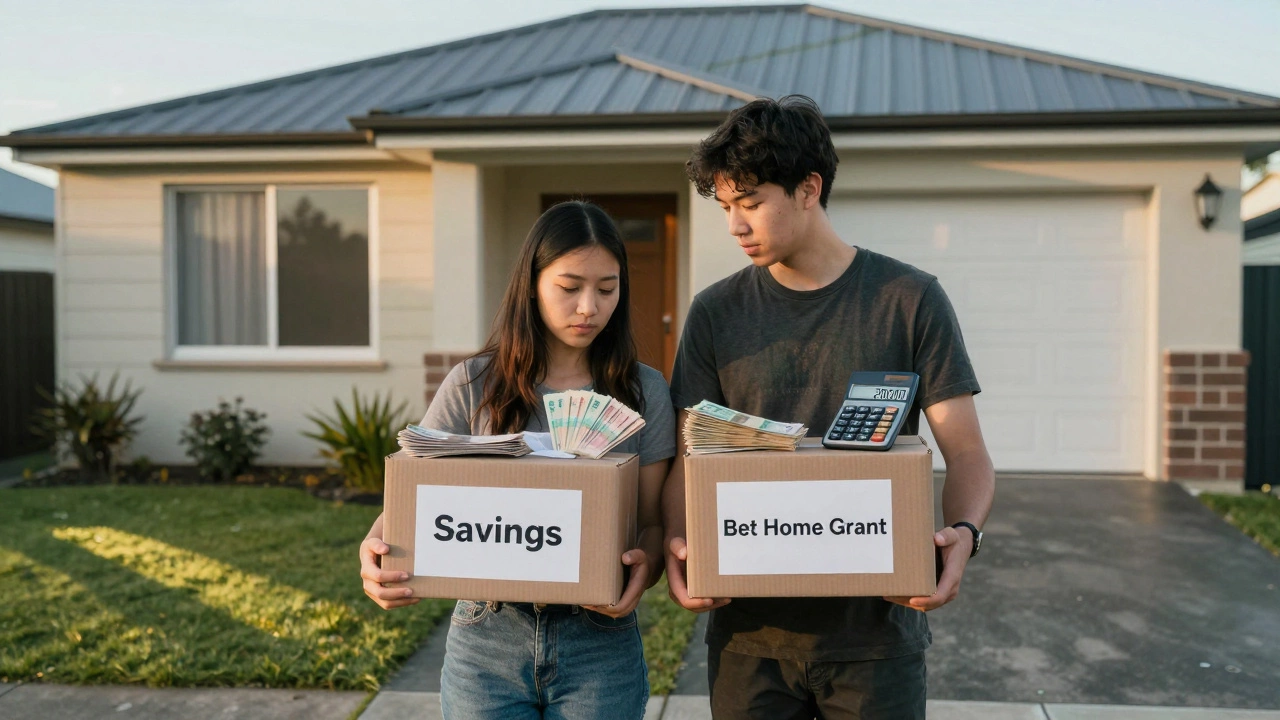
Buying your first home in New Zealand feels exciting - until you realize how much cash you actually need upfront. If you're looking at a $200,000 house, the downpayment isn't just a number on a spreadsheet. It’s your entire savings, your budget, and maybe even your parents’ help. So how much do you really need? Let’s cut through the noise.
Minimum Downpayment in New Zealand
In New Zealand, most lenders require at least a 10% downpayment for first-time buyers. That means for a $200,000 house, you’ll need $20,000 saved up. That’s the baseline. Some lenders might accept 5%, but those are rare and usually come with extra conditions - like mandatory financial counseling or higher interest rates.
Why 10%? It’s not random. The Reserve Bank of New Zealand introduced Loan-to-Value Ratio (LVR) rules in 2016 to cool overheated housing markets. Banks can’t lend more than 80% of a property’s value to first-time buyers unless they meet strict income and savings tests. So unless you’re in a very specific situation, 10% is the number you should plan for.
What Happens If You Put Down Less Than 10%?
You can technically put down 5%, but it’s not easy. Lenders who allow it usually require:
- Proof of at least 6 months of consistent savings
- A clean credit history with no missed payments
- Income that’s 4.5x higher than your monthly mortgage repayments
- Completion of a government-approved financial education course
Even then, you’ll pay more in lender’s mortgage insurance (LMI). That’s not a government fee - it’s charged by the bank to protect themselves. For a $200k home with a 5% deposit, that could add $4,000-$6,000 to your upfront costs. So while you’re saving $5,000 on your deposit, you’re spending more elsewhere.
Where Does the Rest of the Money Go?
Your downpayment isn’t the only cash you’ll need. There are other costs built into buying a home that many first-timers overlook:
- Legal fees - $1,500 to $2,500 for a solicitor to handle the contract and title transfer
- Building inspection - $500 to $1,000 to check for hidden damage
- Valuation fee - $300 to $600, required by your lender
- Home insurance - $800-$1,200 per year, paid upfront at settlement
- Moving costs - $500-$2,000 depending on distance and help needed
That’s another $4,000-$7,000 on top of your deposit. So if you’re aiming for a $200k house, you should realistically have $25,000-$27,000 saved. Not $20,000.
First-Time Buyer Grants and Help
New Zealand has programs to help first-time buyers bridge the gap:
- First Home Grant - Up to $10,000 for singles, $20,000 for couples. You must earn under $120,000 (single) or $180,000 (couple), and the house must be under $500,000 in Auckland or $450,000 elsewhere. The property must be new or existing - not a section or land-only purchase.
- First Home Loan - Allows 5% deposits through Kāinga Ora, but you still need to meet income limits and pass credit checks.
- Family Guarantee - A parent or close relative can use their home equity to guarantee part of your loan. No deposit needed from you, but your family takes on risk.
These aren’t handouts. You still need to prove you can afford the repayments. And you can only use one grant per household. If you’re eligible, these programs can cut your required savings in half.
Real-World Example: Auckland First-Time Buyer
Take Sarah, 28, working as a nurse in Auckland. She earns $75,000 a year. She’s been saving $800 a month for two years. That’s $19,200 saved. She found a $200,000 house in Papakura - outside the most expensive zones.
She qualifies for the First Home Grant because her income is under the limit and the house is under $450,000. She gets $10,000. That cuts her needed savings to $10,000. She still needs $4,500 for legal fees, inspection, insurance, and moving. So she’s short $5,300.
Her mum helps her with a $5,000 gift. She uses the rest from her savings. She’s now at $20,000 deposit + $4,500 costs. She qualifies for a 10% LVR loan. She closes on the house in six weeks.
That’s how it works in real life - not in theory.

What If You Don’t Have Enough?
If you’re short on savings, don’t panic. Here are your real options:
- Wait and save more - Aim for 15% instead of 10%. That gives you better interest rates and more negotiating power.
- Look outside Auckland - Houses under $200k are still available in Hamilton, Tauranga, or Palmerston North. You might get a bigger house for the same price.
- Buy a section and build - Land-only purchases have lower LVR rules. You can get a 15% deposit for land, then build later.
- Get a co-buyer - A friend or sibling can join the loan. Their income helps you qualify. But make sure you have a legal agreement in place.
There’s no shame in waiting. The market doesn’t disappear. Rushing into a house you can’t afford leads to stress, missed payments, and even losing your home.
How Long Will It Take to Save?
Let’s say you need $25,000 total. If you save $500 a month, it’ll take you 4 years and 2 months. $1,000 a month? Just over 2 years. $1,500? Under 18 months.
That’s the real math. No magic tricks. No get-rich-quick schemes. Just consistent saving. The average first-time buyer in New Zealand takes 3-4 years to save. That’s normal.
Track your spending. Use the 50/30/20 rule: 50% needs, 30% wants, 20% savings. That’s not a suggestion - it’s your path to ownership.
Final Advice: Don’t Just Look at the Price
A $200,000 house isn’t just about the sticker price. It’s about:
- How much you’ll pay each month (mortgage, rates, insurance)
- Whether you can handle repairs (a 30-year-old roof isn’t free)
- If the area has good schools, transport, and future development
- Whether you’ll still be happy there in five years
Don’t fall for the trap of buying the cheapest house. Buy the one that fits your life - not just your bank account.