Cost of Living Comparison Tool
Your Current Location
Target State
Cost Comparison
Current State
Target State
Savings Potential
Annual savings potential
Key Cost Factors
When you’re looking for a fresh start, a bigger yard, or just a way to stretch your paycheck further, the cheapest state to live in isn’t just about cheap houses for sale-it’s about what you get for every dollar you spend. In 2025, the answer isn’t a single surprise. It’s a pattern. And it’s not always where you think.
Mississippi leads in affordability, but it’s not just about home prices
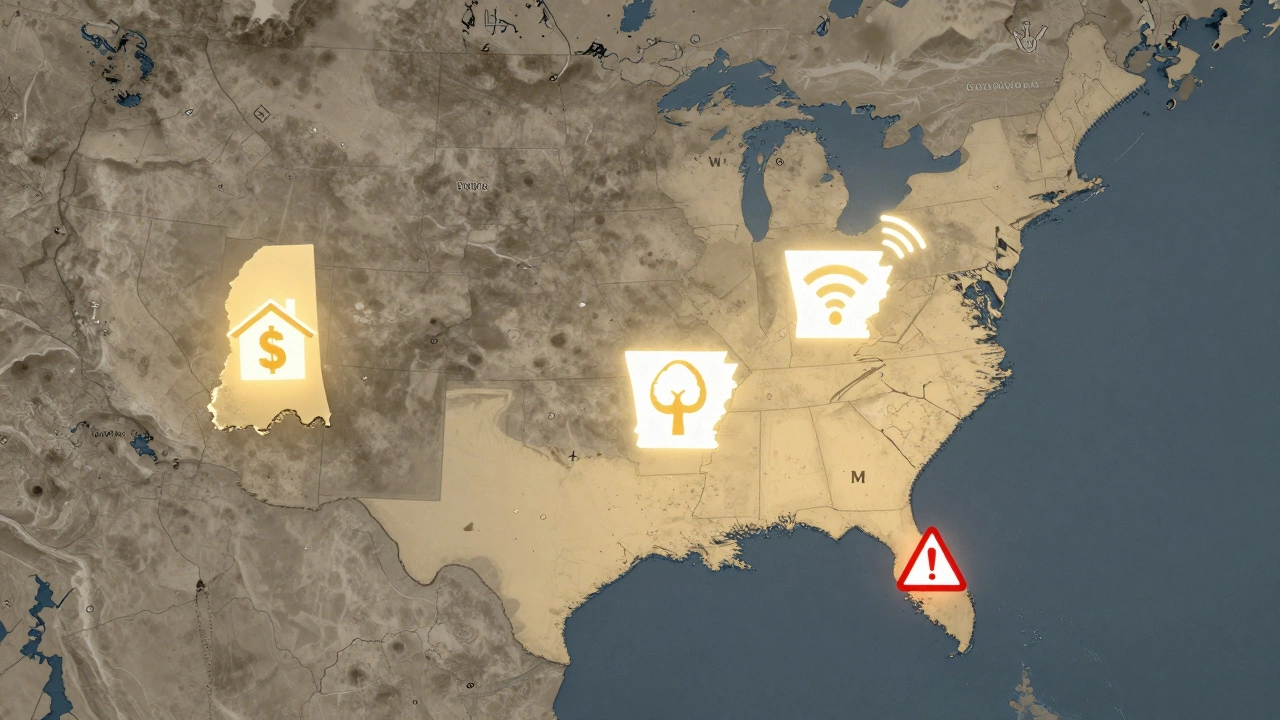
Mississippi is consistently ranked as the cheapest state to live in, and for good reason. The median home price hovers around $185,000-nearly half the national average. But the real win isn’t just the sticker price. Utilities are 18% lower than the U.S. average. Property taxes? One of the lowest in the country at just $650 per year on a $200,000 home. Groceries and gas cost less than in 48 other states. A single person can live comfortably on $38,000 a year in Jackson, including rent or mortgage, food, transportation, and basic healthcare.
That doesn’t mean it’s perfect. Job opportunities in tech or high-paying fields are limited. Public transit is almost nonexistent. But if you work remotely, run a small business, or don’t need to commute far, Mississippi offers unmatched value. You can buy a 3-bedroom, 2-bath home on a quarter-acre lot for less than what a studio apartment costs in Chicago or San Francisco.
West Virginia and Arkansas: hidden bargains with strong roots
West Virginia and Arkansas tie closely behind Mississippi. In West Virginia, the median home price is $192,000. In Arkansas, it’s $195,000. Both states have property tax rates under 0.8%, and neither has a state income tax on Social Security. In Fayetteville, Arkansas, you’ll find walkable neighborhoods, a growing food scene, and a University of Arkansas campus that keeps the local economy active. In Huntington, West Virginia, you can buy a 1920s brick bungalow with original woodwork for under $120,000.
These aren’t ghost towns. They’re places where people are moving back-especially after the pandemic. Remote workers traded city rents for porches, gardens, and lower stress. Schools in rural districts may not have the latest tech, but class sizes are small and community ties run deep. If you value space, quiet, and a slower pace, these states deliver.
Why some cheap states aren’t for everyone
Not every low-cost state is a good fit. Take Alabama. It has cheap homes-median price around $200,000-but healthcare access is thin outside major cities. In rural counties, you might drive 45 minutes to see a specialist. In Louisiana, home prices are low, but insurance costs are sky-high because of hurricane risk. Flood zones cover nearly 20% of the state. You could buy a house for $150,000, but your annual flood insurance bill could be $3,000.
Same goes for parts of Ohio and Indiana. Cities like Cleveland and Indianapolis have affordable homes, but neighborhoods vary wildly. A $100,000 house in a good school district might be 30 miles from your job. That’s 45 minutes each way, adding up to $5,000 a year in gas and wear-and-tear. Cheap housing doesn’t mean cheap living if your commute eats your savings.

What’s really driving affordability in 2025?
It’s not just about supply and demand anymore. Three things are reshaping affordability:
- Remote work flexibility-People no longer need to live near their job. A software engineer in Texas can work for a New York company and live in Missouri.
- State tax policies-Nine states have no income tax: Alaska, Florida, Nevada, South Dakota, Tennessee, Texas, Washington, Wyoming, and New Hampshire (though it taxes interest and dividends). That’s a direct boost to take-home pay.
- Infrastructure investment-States like Georgia and Tennessee are expanding broadband and roads in rural areas, making them more attractive to remote workers.
These shifts mean affordability isn’t static. A state that was cheap five years ago might be heating up now. In 2023, Tennessee’s median home price jumped 14% in just 12 months. Places like Chattanooga and Knoxville are seeing out-of-state buyers snap up homes faster than they can be built.
What to look for beyond the listing price
If you’re hunting for cheap houses for sale, don’t just check Zillow. Dig deeper. Here’s what matters:
- Property taxes-A $150,000 home in New Jersey could cost $8,000 a year in taxes. In Oklahoma, it’s $1,200.
- Homeowners insurance-Coastal areas, wildfire zones, and tornado-prone regions have premiums that can double your monthly cost.
- Utility costs-In Pennsylvania, natural gas is cheap. In California, electricity prices are among the highest in the nation.
- Healthcare access-A $120,000 home in rural Montana means a 60-mile drive to the nearest ER. Is that worth it?
- Job market-Can you work locally? Or will you need to commute or relocate again?
One family in rural Kentucky bought a 2,400-square-foot farmhouse for $95,000. They paid $450 a year in property taxes. Their monthly utility bill? $110. They work remotely and have no car payment. Their total monthly housing cost: $850. In Chicago, that same $850 would barely cover rent for a studio.
Who benefits most from living in the cheapest states?
Retirees on fixed incomes. Remote workers. Young families who want more space. Teachers and nurses who can’t afford city living. People who value time over convenience.
But it’s not for everyone. If you need nightlife, public transit, top-tier schools, or high-paying corporate jobs, you’ll likely need to compromise. The cheapest states often trade convenience for cost. You won’t find a 24-hour pharmacy on every corner. You might not get same-day delivery. But you’ll get a backyard, a quiet street, and a mortgage payment that doesn’t eat half your paycheck.
Real examples: What 0,000 buys in the cheapest states
Let’s compare what $200,000 gets you in three states:
| State | Home Type | Lot Size | Property Tax | Monthly Utilities |
|---|---|---|---|---|
| Mississippi | 4-bedroom, 2-bath ranch | 0.5 acre | $650/year | $105 |
| Arkansas | 3-bedroom, 2-bath split-level | 0.3 acre | $720/year | $110 |
| Ohio (rural) | 3-bedroom, 1-bath farmhouse | 2 acres | $1,400/year | $135 |
Notice something? Ohio’s home is bigger and on more land, but property taxes are more than double Mississippi’s. That’s the trade-off. You’re paying more in taxes, but you get space. In Mississippi, you pay less overall, but you sacrifice land and sometimes amenities.
Where’s the next cheap state to watch?
Look at Missouri. It’s not yet in the top five for affordability, but it’s rising fast. Kansas City has seen a 12% drop in home prices since early 2024. The state has no estate tax, low property taxes, and a booming remote-work hub in Columbia. It’s becoming a magnet for people from Illinois and Iowa who want to escape high taxes without leaving the Midwest.
Also keep an eye on parts of Kentucky and West Virginia near the Ohio River. New highway projects and fiber-optic expansion are making these areas more connected than ever. Prices haven’t spiked yet-but they will.
Final advice: Don’t just chase the lowest price
The cheapest state to live in isn’t the one with the lowest home price. It’s the one where your money goes furthest across all your expenses. That means looking at taxes, insurance, utilities, healthcare, and commute costs-not just the listing.
Visit before you buy. Talk to locals. Check the school district ratings-even if you don’t have kids. See how often the power goes out in winter. Ask about internet reliability. Drive the roads at rush hour, even if you don’t plan to commute.
There’s no perfect place. But there is a right place for you. And if you’re ready to trade city noise for quiet, and high rent for a mortgage you can actually afford, the cheapest states are waiting.
What is the cheapest state to live in for retirees?
Mississippi and West Virginia are the top choices for retirees. Both have no state income tax on Social Security, low property taxes, and affordable healthcare. A retiree on $30,000 a year can live comfortably, with plenty left over for travel or hobbies. Mississippi’s cost of living is 15% below the national average, making it one of the most budget-friendly states for fixed incomes.
Is it safe to buy a home in a cheap state?
Yes-but do your homework. Some low-cost areas have higher crime rates or older infrastructure. Check local crime stats on official police websites. Look for homes with updated plumbing, electrical, and roofing. Avoid properties in flood zones unless you’re willing to pay high insurance. A $100,000 home in a good neighborhood is better than a $70,000 home in a declining area.
Can I afford to move to a cheaper state if I have a job?
If your job is remote, absolutely. Even if you work in person, many cheaper states have lower salaries-but also much lower living costs. A $50,000 salary in Arkansas buys more than a $75,000 salary in New York. Use a cost-of-living calculator to compare your current city to your target. Most people find they can save thousands a year just by relocating.
Do cheap states have good schools?
It varies. Rural districts often have smaller class sizes and strong community support, but fewer advanced courses or extracurriculars. Urban areas in states like Arkansas and Missouri have improved public schools in recent years. Check GreatSchools.org for ratings. If education is a priority, target cities like Fayetteville (AR) or Columbia (MO), where schools are above state averages.
Are property taxes really that low in these states?
Yes. In Mississippi, the average effective property tax rate is 0.31%. In Arkansas, it’s 0.42%. Compare that to New Jersey (2.21%) or Illinois (2.04%). That means on a $200,000 home, you pay $620 a year in Mississippi versus $4,420 in New Jersey. That’s a $3,800 annual difference-enough to cover a car payment or a vacation.
Before you make a move, remember: affordability isn’t just about the price tag. It’s about what you get after the bills are paid. The cheapest state to live in isn’t the one with the cheapest house. It’s the one where you can finally breathe easier.