
ADHD Accommodation Planner
Identify Your Student's Challenges
Select the challenges your student faces. This tool will help you identify effective accommodations based on their specific needs.
When a student with ADHD walks into a classroom, they’re not being lazy. They’re not being disruptive on purpose. They’re not choosing to zone out or forget their homework. Their brain works differently - and that’s not a flaw. It’s a neurological reality. So why should students with ADHD get accommodations? Because without them, school doesn’t just become harder - it becomes unfair.
ADHD Isn’t a Behavior Problem - It’s a Brain Wiring Issue
Attention Deficit Hyperactivity Disorder (ADHD) isn’t about poor discipline or lack of motivation. It’s a neurodevelopmental condition rooted in how the brain manages attention, impulse control, and executive function. Studies show that students with ADHD have differences in the prefrontal cortex - the part of the brain responsible for planning, organizing, and staying focused. This isn’t something they can just "try harder" to fix. It’s like asking someone with nearsightedness to see the board without glasses. The system isn’t designed for their brain.In New Zealand, about 5% of school-aged children are diagnosed with ADHD. That’s roughly one student in every classroom. But many more go undiagnosed, especially girls and students from marginalized backgrounds. These kids aren’t "bad" or "unmotivated." They’re trying to navigate a system built for neurotypical learners - and they’re failing because the system doesn’t adapt to them.
What Kind of Accommodations Actually Help?
Accommodations aren’t about giving students an easy way out. They’re about removing barriers so learning can happen. Think of them like ramps for wheelchairs - they don’t change the goal, they make access possible.- Extended time on tests - Students with ADHD often need more time to process questions, manage anxiety, and avoid rushing due to impulsivity. Research from the American Psychological Association shows that extended time can improve test scores by up to 30% for students with ADHD.
- Breaks during class - Sitting still for 45 minutes is physically hard for many with ADHD. Short, scheduled movement breaks help reset focus and reduce fidgeting that distracts others.
- Quiet testing environments - Background noise, movement, or even the sound of a pencil dropping can derail attention. A quiet room isn’t a luxury - it’s a necessity.
- Chunked assignments - Instead of one big project due in two weeks, breaking it into smaller steps with deadlines helps students stay on track without feeling overwhelmed.
- Visual schedules and reminders - Written or digital checklists help compensate for working memory challenges. A sticky note on a desk isn’t coddling - it’s scaffolding.
These aren’t special privileges. They’re evidence-based strategies used in schools across the U.S., Canada, Australia, and New Zealand. And they work.
The Cost of Not Accommodating
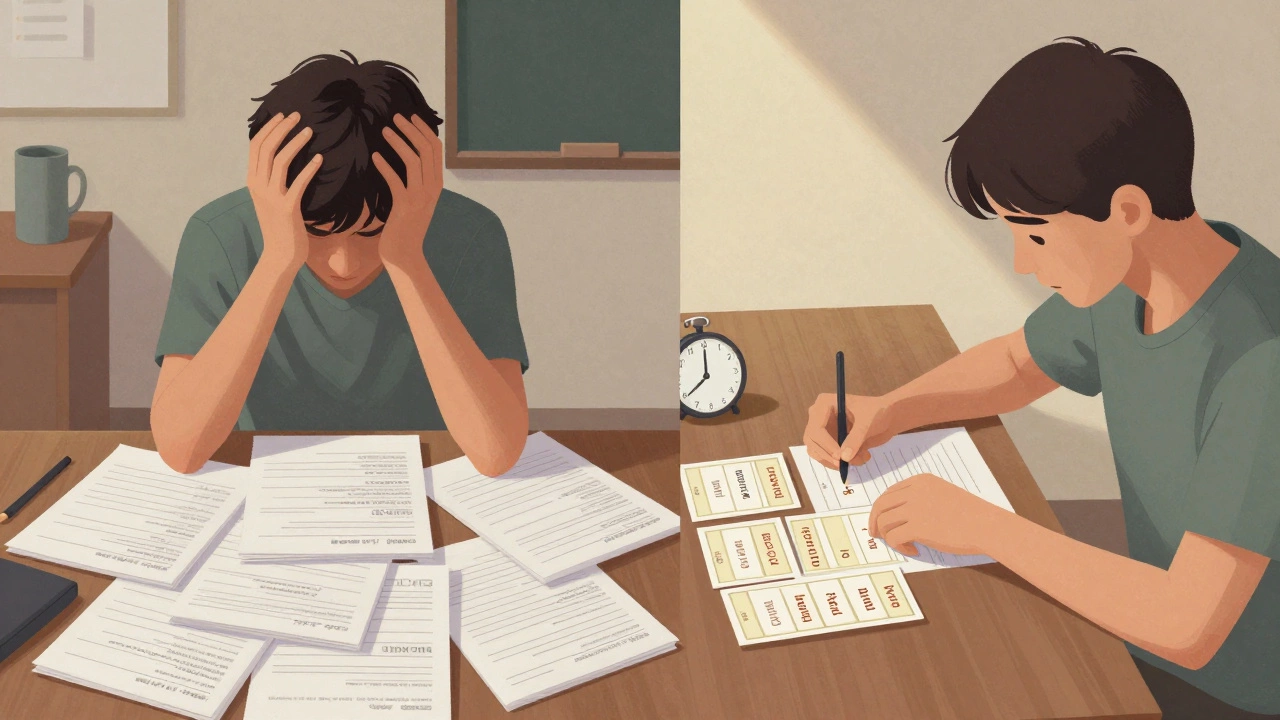
Without support, students with ADHD fall behind - not because they’re dumb, but because they’re constantly fighting an uphill battle.- They’re more likely to be suspended or labeled as "troublemakers."
- They’re twice as likely to drop out of high school.
- They’re at higher risk for anxiety, depression, and low self-esteem by age 15.
A 2023 study from the University of Auckland tracked 1,200 secondary students with undiagnosed ADHD. Those who didn’t receive accommodations were 7 times more likely to report feeling "useless" in class compared to those who did. The emotional toll is real - and it lasts long after school ends.
Accommodations Aren’t Just Fair - They’re Legal
In New Zealand, the Education and Training Act 2020 requires schools to make reasonable adjustments for students with disabilities - including ADHD. This isn’t optional. It’s the law. Schools can’t say, "We don’t have the resources" and walk away. They must work with families and specialists to find practical solutions.Many schools still don’t know how to implement accommodations properly. Some think it’s about giving extra time only. But true inclusion means changing how instruction is delivered, how feedback is given, and how success is measured. It’s not about lowering standards - it’s about rethinking how those standards are reached.
Myth: Accommodations Give Unfair Advantage
Some people argue that giving a student with ADHD extra time on a test is unfair to others. But here’s the truth: fairness doesn’t mean treating everyone the same. It means giving everyone what they need to succeed.Imagine two runners. One has a broken leg. You give them a wheelchair. Is that unfair to the other runner? No. It’s justice. The goal isn’t to make everyone run the same way - it’s to make sure everyone can cross the finish line.
Same with school. A student with ADHD isn’t getting an advantage. They’re getting access.

What Parents and Teachers Can Do
If you’re a parent, you don’t need to be a lawyer to request accommodations. Start by talking to the school’s special education coordinator. Bring documentation - a letter from a psychologist or doctor is helpful, but not always required. Schools are obligated to act on observable needs.Teachers, you don’t need a degree in neuroscience to help. Small changes make big differences:
- Seat the student near the front - away from windows and distractions.
- Give verbal and written instructions - don’t rely on one.
- Use timers to signal transitions - "You have 5 minutes left to finish this."
- Praise effort, not just results. "I saw how you stayed focused for 20 minutes - that’s huge."
And remember: accommodations aren’t a one-time fix. They evolve. What works in Year 9 might not work in Year 12. Keep checking in.
Real Change Starts with Understanding
The biggest barrier to accommodations isn’t funding. It’s misunderstanding.Students with ADHD aren’t broken. They’re different. And different doesn’t mean less capable. Many of the world’s most creative problem-solvers, entrepreneurs, and innovators have ADHD. They didn’t succeed because they were "fixed." They succeeded because someone saw their potential - and gave them the tools to reach it.
Every student deserves a chance to learn. Not just the ones who fit neatly into a mold. The ones who fidget, forget, and daydream? They’re not the problem. The system is. And it’s time to change it.