
New Zealand House Purchase Calculator
Enter your details above to see your results.
Is $20,000 enough to buy a house in New Zealand? If you’re a first-time buyer, that question keeps you up at night. You’ve saved for years. You’ve skipped vacations, packed lunches, and said no to new phones. Now you’re looking at a $20,000 deposit and wondering: is this enough?
What $20,000 Actually Buys in Today’s Market
In Auckland, $20,000 as a down payment means you’re looking at a house priced around $400,000 - assuming you’re getting a 95% loan-to-value ratio (LVR). That’s the highest most banks will lend to first-time buyers without mortgage insurance. Outside the big cities, you might find homes in the $300,000-$350,000 range with the same deposit. But here’s the catch: those homes are often older, in need of repairs, or located far from public transport and schools.
In 2025, the average house price in New Zealand is $890,000. That’s up from $750,000 in 2023. But the market isn’t flat. Some suburbs in Hamilton, Tauranga, and even parts of Wellington still have homes under $450,000. If you’re flexible on location, $20,000 can get you in the door. But if you’re set on a three-bedroom house in a good school zone in Auckland, you’ll need closer to $80,000-$100,000.
Can You Even Get a Loan With $20,000?
Banks in New Zealand are strict about lending to first-time buyers. To get a 95% loan, you need more than just a deposit. You need:
- A clean credit history - no late payments in the last 12 months
- Stable income - at least six months of consistent employment
- Proof you can handle repayments - banks stress-test your loan at 7% interest, even if current rates are 5%
- Additional savings for fees - $5,000-$10,000 extra for legal costs, inspections, and moving
That means $20,000 isn’t just your deposit. It’s your entire upfront budget. If you spend $18,000 on the deposit, you’ve got $2,000 left for everything else. That’s not enough. Most lenders will ask you to show you’ve saved at least $5,000 beyond the deposit as a buffer. Some even want you to have six months of repayments saved up.
The Hidden Costs No One Tells You About
Buying a house isn’t just the price tag. There’s a whole list of fees you can’t ignore:
- Legal fees: $1,500-$3,000
- Building inspection: $500-$1,200
- Valuation fee: $300-$600
- Home insurance: $1,000-$2,000/year
- Mortgage insurance (if under 20% deposit): 1.5%-3% of the loan amount
- Moving costs: $800-$2,500
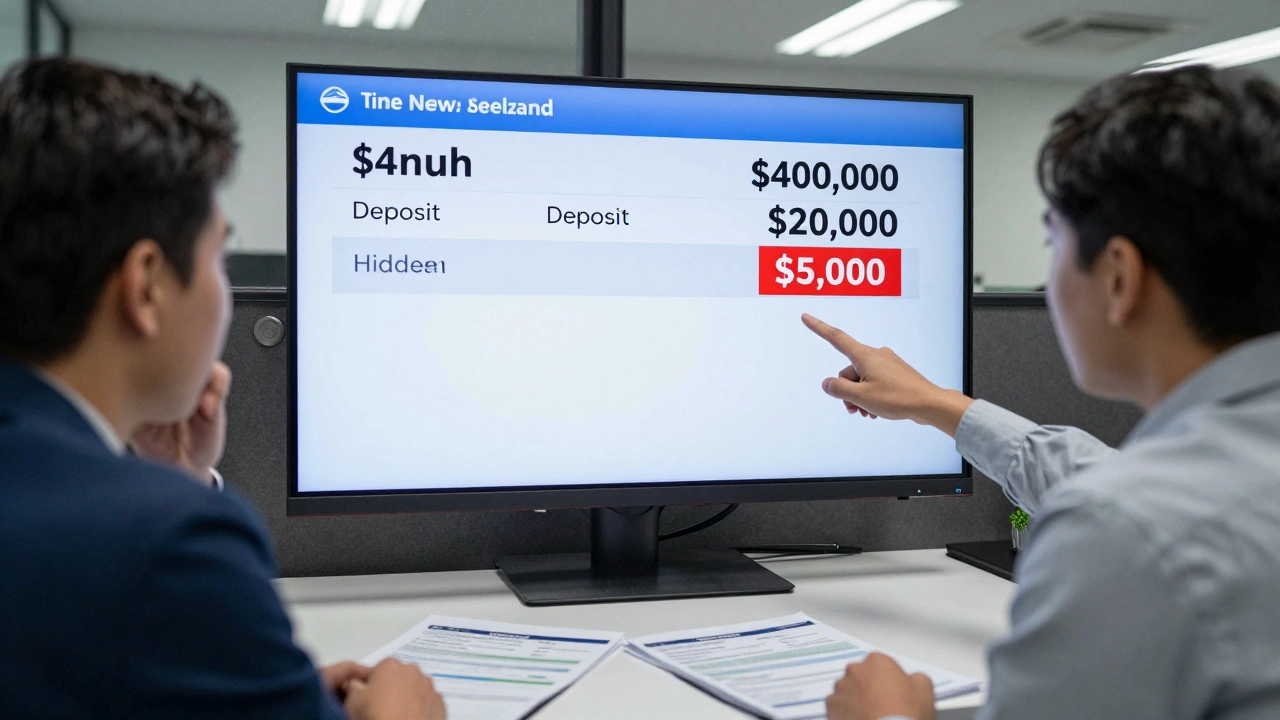
For a $400,000 house with a $20,000 deposit, mortgage insurance could cost you $5,000-$10,000. That’s not optional. It’s required. So if you think you’re spending $20,000 to buy a house, you’re actually spending $25,000-$30,000 just to get through the door.
What Happens After You Buy?
Many first-time buyers think once they’ve got the keys, the hard part is over. It’s not. A $400,000 house with a 95% loan means your monthly repayments will be around $2,100-$2,400 at current interest rates. Add rates to that, and you’re looking at $2,700+ if rates climb again.
That’s more than most people earn in entry-level jobs. If you’re working part-time, on a contract, or in a seasonal industry, you’re one missed paycheque away from falling behind. There’s no safety net. No equity to borrow against. No room for error.
And repairs? Older homes need them. A leaking roof, a broken boiler, or cracked foundations can cost $10,000-$20,000. If you’ve spent every dollar on the deposit, you won’t have a cent left. That’s how people get trapped - not because they bought too early, but because they bought with no buffer.
Alternatives to $20,000 Down
You don’t have to wait until you’ve saved $100,000 to buy a house. But you do need a smarter strategy.
- First Home Buyer Grant: If you’re buying a new build under $800,000, you might qualify for up to $10,000 from the government. That cuts your deposit requirement.
- Family Help: Many first-time buyers get help from parents. A gift or loan from family can cover the gap between your savings and the required deposit. Just make sure it’s documented properly - banks require proof it’s not a loan.
- Shared Ownership: Some schemes let you buy a share of a home (like 50%) and rent the rest. That reduces your upfront cost and monthly repayments.
- Regional Areas: Consider towns like Whanganui, Gisborne, or Hawke’s Bay. Homes there can be $200,000-$300,000. A $20,000 deposit gets you into a solid property with room to grow.

When ,000 Is Enough - And When It’s Not
Here’s the truth: $20,000 can work - if you’re realistic.
It works if:
- You’re buying in a low-cost region
- You’re okay with a small, older, or fixer-upper home
- You have stable income and no other debt
- You’ve saved extra for fees and emergencies
- You’re prepared to live there for 5+ years
It doesn’t work if:
- You’re in Auckland, Wellington, or Christchurch and want a modern home
- You have credit card debt, student loans, or car payments
- You plan to move in 2-3 years
- You don’t have a backup plan if interest rates rise
What to Do Next
If you’re serious about buying with $20,000, start here:
- Check your credit score - aim for 700+ on the Credit Information Bureau scale
- Use the Kāinga Ora homebuyer calculator to see what you can afford
- Get pre-approved for a mortgage - don’t wait until you find a house
- Visit at least 10 homes in your target area - get a feel for what $400,000 buys
- Meet with a mortgage broker who knows first-time buyer programs
Don’t rush. Don’t feel pressured by social media or friends who bought five years ago. The market changes. Your plan should too.
Frequently Asked Questions
Can I buy a house with $20,000 in New Zealand?
Yes, but only if you’re buying a low-cost home in a regional area, like Whanganui or Gisborne, and you’ve saved extra for fees. In Auckland or Wellington, $20,000 is usually not enough to cover both the deposit and closing costs.
How much deposit do I need for a $400,000 house?
Banks require at least 5% for first-time buyers, which is $20,000. But you’ll also need $5,000-$10,000 for legal fees, inspections, and mortgage insurance. So plan for $25,000-$30,000 total.
Is $20,000 a good down payment?
It’s the minimum - not ideal. A 20% deposit ($80,000 on a $400,000 home) gives you lower interest rates, no mortgage insurance, and more breathing room. But if you’re a first-time buyer with limited savings, $20,000 can be a realistic starting point - if you’re prepared for the trade-offs.
What’s the First Home Buyer Grant?
The First Home Buyer Grant gives up to $10,000 to eligible buyers purchasing a new build under $800,000. You must be a first-time buyer, earn under $120,000 (or $180,000 for two people), and live in the home for at least six months. It’s not available for existing homes.
Can I use KiwiSaver for a house deposit?
Yes. If you’ve been in KiwiSaver for at least three years, you can withdraw your contributions, employer payments, and government contributions (but not the member tax credit) for a first home. You can also apply for the First Home Withdrawal - this is separate from the Grant. Together, they can add $15,000-$30,000 to your deposit.