
Shared Ownership Home Calculator
Enter Your Details
How It Works
This calculator shows your rent payments based on New Zealand shared ownership patterns. Your rent is typically 2.75% of the unsold share annually.
Your Results
When you buy a shared ownership home, you’re not buying the whole house. You’re buying a piece of it-usually between 25% and 75%-and paying rent on the rest. But what does that actually look like over time? The pattern of share ownership isn’t just a one-time decision. It’s a journey. And if you don’t understand how it works, you could end up stuck, overpaying, or missing chances to own more.
How Share Ownership Starts
Most shared ownership homes in New Zealand start with a minimum 25% share. That means if a property is worth $600,000, you buy $150,000 worth (25%) and pay rent on the other $450,000 to the housing provider. The rent isn’t set by the market-it’s usually around 2.75% of the unsold share per year. So in this case, you’d pay about $12,375 a year in rent, or $1,030 a month. This setup is designed for people who can’t afford a full mortgage but can manage smaller payments. It’s common in Auckland, Wellington, and Christchurch, where house prices have outpaced wages for over a decade. You get a foot in the door without needing a 20% deposit on a full property.The Pattern: Buying More Shares Over Time
The real power of shared ownership comes from staircasing-buying more shares in your home over time. This isn’t optional. It’s the whole point. The pattern isn’t random. It follows a clear rhythm:- You buy your first share (usually 25-50%)
- After 1-2 years, you can buy another 10-25%
- Each time you buy more, your rent goes down
- You can keep buying until you own 100%
What Happens When You Own 100%
Once you own the full share, you stop paying rent. You still have a lease, but it’s no longer a shared ownership lease. It becomes a standard leasehold, like any other property. You can sell it on the open market, refinance, or even rent it out-though some housing providers restrict this. But here’s the catch: when you buy the final share, you pay the current market value. Not the original price. If your home went up 30% since you bought it, you pay 30% more for that last share. That’s not a trick. It’s fair. The housing provider didn’t make money off your rent-they just held the asset for you. In Wellington, a couple bought a shared ownership flat in 2020 for $480,000. They started with 40% ($192,000). By 2025, the same flat was valued at $624,000. To buy the final 60%, they paid $374,400-not the original $288,000. That’s a $86,400 difference. They were shocked, but they understood: they’d benefited from the price rise. They just hadn’t factored it into their budget.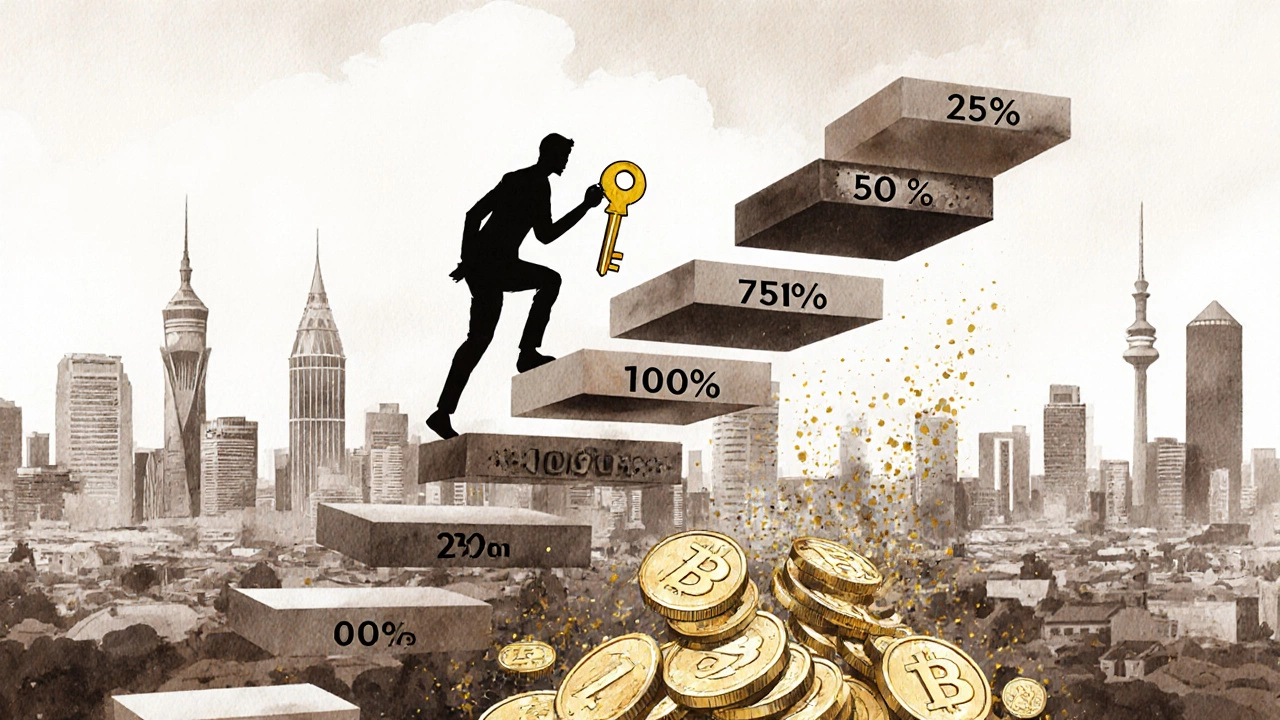
When Staircasing Gets Tricky
Not everyone can staircase smoothly. Here are the three biggest pitfalls:- Valuation delays - Housing providers use certified surveyors to value your home before you buy more shares. If they’re slow, you might wait 8-12 weeks. That can mess up your mortgage approval timeline.
- Unexpected fees - Legal fees, valuation fees, and lender fees add up. Each staircasing step can cost $2,000-$4,000. Many buyers forget this and run out of cash.
- Income limits - Some providers cap your income if you want to buy more shares. If you got a big raise, you might be blocked from buying the final 25%. This rule exists to keep shared ownership for people who need it.
Who Benefits Most From This Pattern?
Shared ownership isn’t for everyone. It works best for:- First-time buyers with steady income but not enough for a full deposit
- People who expect their income to grow over 3-5 years
- Those who want to build equity without the burden of full homeownership
- Anyone who plans to stay in one place for at least 5 years
- You might move in 2-3 years (selling a shared ownership home is slower)
- You’re unsure about your long-term income
- You dislike dealing with two parties: your lender and the housing provider

What You Should Do Now
If you’re considering shared ownership, don’t just look at the initial cost. Look at the full pattern:- Ask your provider: What’s the minimum share I can buy? What’s the maximum?
- Ask: How often can I staircase? Are there time limits?
- Ask: Who does the valuation? How long does it take? What are the fees?
- Ask: Is there an income cap for buying more shares?
- Run the numbers: What will your rent be at 50%? At 75%? At 100%?
What Happens If You Can’t Buy More?
You’re not stuck forever. If you can’t afford to staircase, you can stay in your home as long as you like. You keep your share. You keep paying rent. You can even sell your share back to the housing provider-or sell it to someone else who qualifies for shared ownership. Some people choose this path because they’re happy renting the rest. Others do it because their income didn’t grow as expected. That’s okay. Shared ownership isn’t a race. It’s a flexible path.Final Thought: It’s Not Renting. It’s Building.
The pattern of share ownership isn’t about getting a cheap rent. It’s about building ownership slowly, safely, and with support. You’re not just paying for a place to live-you’re building equity, one step at a time. In 2025, over 12,000 New Zealanders live in shared ownership homes. Most of them started with less than 30%. Now, nearly 40% own 100%. That’s not luck. That’s the pattern working.Can I buy 100% of a shared ownership home?
Yes, you can buy 100% of a shared ownership home through a process called staircasing. You buy additional shares in increments, usually 10-25% at a time, until you own the entire property. Once you reach 100%, you no longer pay rent, but you still hold a leasehold title. The final share is priced at the current market value, not the original purchase price.
How often can I buy more shares?
Most housing providers allow you to staircase once every 12 months, though some let you do it more often. You must wait at least one year after your last purchase to avoid fees and administrative overload. Always check your lease agreement-some providers have a minimum share size you must hold before buying more (e.g., you can’t go from 75% to 100% in one step if your lease says you must hold at least 50% for two years).
Do I need a new mortgage for each staircasing step?
Yes, each time you buy more shares, you’ll need to apply for a new mortgage to cover the additional cost. Your lender will reassess your income, credit score, and affordability. You’ll also need a new valuation of the property. This can take 6-12 weeks, so plan ahead and avoid tying up your savings in other expenses.
What happens if my home’s value drops?
If your home’s value drops, you still pay the current market value when buying more shares. But you won’t be forced to buy more. You can stay at your current share level. Some providers even let you delay staircasing if the market falls. Your rent will adjust slightly based on the new valuation, but you won’t owe money just because prices dropped. The system is designed to protect you from market swings.
Can I sell my shared ownership home?
Yes, you can sell your share at any time. If you own 100%, you can sell it like any other property. If you own less, the housing provider has the right to find a buyer who qualifies for shared ownership. You’ll get the full value of your share based on the current market price. There’s no penalty for selling, but you won’t get the full property value-just your percentage.