Auckland Mortgage Affordability Calculator
Affordability Calculator
Affordability Assessment
UnaffordableYour Total Monthly Housing Costs
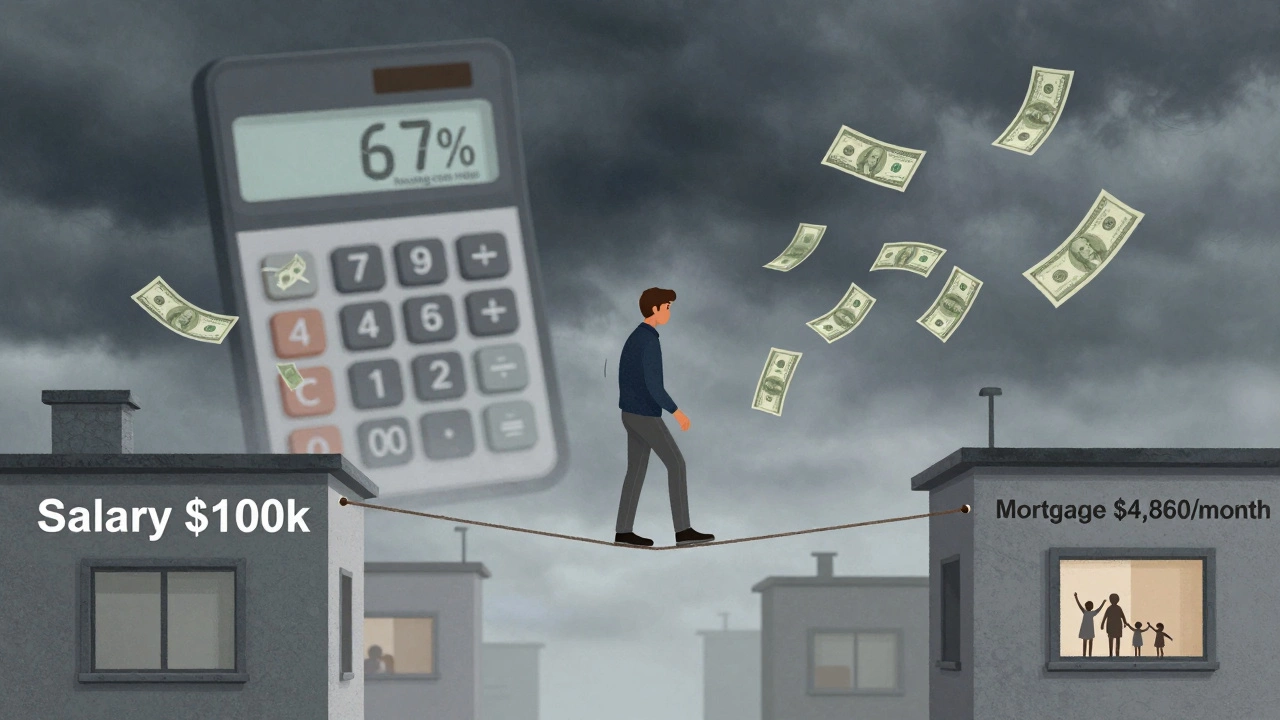
$4,860
Income Percentage
67%
Mortgage Cost
$4,280
Additional Costs
$580
Financial Health Check
Based on Auckland housing costs and Reserve Bank guidelines, your monthly housing costs represent 67% of your income. Financial experts recommend keeping housing costs below 30% of your take-home pay.
At 8.5% stress testing rate, your costs would increase to $5,380, leaving only $1,820 for all other expenses.
Key Takeaways
- You need at least a 10% deposit ($70,000 for a $700k home)
- Banks require you to qualify at 8.5% interest rate (not your current rate)
- Without family support or co-buyer, this purchase is high-risk
Buying a $700,000 house on a $100,000 salary isn’t impossible in Auckland - but it’s not easy either. If you’re a first-time buyer, you’ve probably heard stories of people snapping up homes with 20% deposits and perfect credit. The truth? Those stories are rare. Most people in your position are juggling high rents, student debt, and rising interest rates. Let’s cut through the noise and see what actually happens when you try to buy a $700k home on $100k a year.
What Does a $700k Mortgage Actually Cost?
Let’s start with the basics. If you put down a 10% deposit - $70,000 - you’ll need to borrow $630,000. At today’s average fixed rate of 7.2% (as of November 2025), your monthly repayment on a 30-year loan would be about $4,280. That’s not a guess. That’s what the Reserve Bank of New Zealand’s mortgage calculator shows for a standard loan.
Now, add rates, insurance, and maintenance. In Auckland, rates for a $700k house average $4,200 a year. That’s $350 a month. Home insurance? Another $100-$150. Water and waste? Around $80. That’s another $580 a month on top of your mortgage. Total housing cost: $4,860 per month.
That’s more than half your take-home pay. If you earn $100,000 a year, your net income after tax and KiwiSaver is roughly $7,200 a month. So you’re spending 67% of your income just to live in your house. Financial experts say you should aim for 30% or less. You’re already over the red line.
Can You Even Get Approved?
Banks don’t just look at your salary. They look at your living expenses. The Reserve Bank’s Loan-to-Value Ratio (LVR) rules and the External Benchmark for Mortgage Servicing (EBMS) mean lenders have to prove you can still pay your mortgage if rates go up. Right now, they test you at 8.5% - even if your actual rate is 7.2%.
At 8.5%, your $630k loan jumps to $4,800 a month. Add the same $580 in other costs, and you’re looking at $5,380. You need to show you can afford that on $7,200 net. That leaves you with $1,820 a month for food, transport, phone, healthcare, savings, and everything else. That’s $60 a day. No holidays. No car repairs. No unexpected bills. No room for error.
Most lenders also look at your debt-to-income ratio. If you’ve got a student loan, a car payment, or even a credit card with a $5,000 balance, your approval chances drop fast. A $150/month student loan repayment cuts your buffer by 2.5%. A $300/month car loan? That’s 5% gone. You don’t need to be rich - but you need to be debt-light.
Where Do People Actually Get the Deposit?
Most first-time buyers in Auckland don’t save $70,000 on their own. The average person saving $1,500 a month after rent and bills would need nearly 4 years to save that much. That’s if they don’t get sick, lose a job, or have a family emergency.
More common? Family help. Around 42% of first-time buyers in Auckland in 2025 received a gift or loan from parents or relatives, according to the Real Estate Institute of New Zealand. Some families give $30k-$50k. Others co-sign. But if you don’t have that safety net, you’re starting behind the line.
There’s also the First Home Grant - but you can only get it if the house is under $700k. For a $700k house, you’re out of luck. The First Home Loan scheme lets you buy with a 5% deposit, but your income can’t exceed $95,000 for singles. You’re $5,000 over. So you’re stuck with a 10% deposit minimum. No government help. No shortcuts.
What Are Your Real Options?
If you’re serious about buying a $700k house on $100k, you need to adjust your expectations. Here’s what works for people who’ve done it:
- Live with parents or housemates for 2-3 more years - save aggressively. Cut dining out, subscriptions, and weekend trips. Aim for $2,500-$3,000 a month in savings.
- Look outside the city center - suburbs like Papakura, Waiuku, or Clevedon have $700k homes. You’ll get more land, but you’ll add $400-$600 a month in fuel and time.
- Consider a townhouse or duplex - they’re cheaper than standalone homes. You might get a 3-bedroom townhouse in Manukau for $680k instead of a 2-bedroom house in Remuera.
- Buy with a partner - if your partner earns $60k, your combined income is $160k. Suddenly, you’re in a much stronger position. Joint applications are common - and often the only way to make this work.
There’s also the option to buy a fixer-upper. A $600k house needing $100k in renovations might still be cheaper than a $700k move-in-ready home. But you need cash reserves for repairs - and you can’t borrow for them. Banks won’t lend for renovations unless you already own the property.
What Happens If You Buy Anyway?
People do buy houses they can barely afford. They stretch their budgets. They skip vacations. They put off having kids. They work overtime. They live paycheck to paycheck.
But here’s what happens when rates rise again - and they will. In 2023, mortgage payments jumped 40% overnight for many. Those who bought on the edge lost their homes. Others sold at a loss. Some moved back in with parents. A $700k house on a $100k salary isn’t a lifestyle - it’s a high-stakes gamble.
If you go ahead, you’re choosing security over freedom. You won’t be able to change jobs without risking your loan. You won’t be able to take time off. You won’t be able to afford a dental bill without going into debt. That’s not just tight budgeting - that’s financial vulnerability.
Is There a Better Path?
Yes. And it’s not sexy. But it works.
Buy something smaller. A $500k one-bedroom apartment in Manukau. Put down $50k. Your mortgage? $3,000 a month. Rates, insurance, and bills? $450. Total: $3,450. That’s 48% of your take-home pay - still high, but manageable. You build equity. You get off the rental treadmill. You live in Auckland. You don’t need to wait 10 years.
Or wait. Save for 3 more years. Watch the market. Maybe prices dip. Maybe interest rates fall. Maybe your income grows. Maybe you get a promotion. Maybe your partner joins the workforce. The market doesn’t move fast - but it moves. And you don’t have to rush.
The biggest mistake first-time buyers make is thinking they have to buy now. You don’t. Renting isn’t failure. It’s strategy. You’re not behind. You’re buying time.
Final Reality Check
You can technically afford a $700k house on a $100k salary in Auckland. But you can’t afford to breathe. You can’t afford to live.
If you have family support, no debt, and a high savings rate - go for it. But if you’re relying on your salary alone? You’re setting yourself up for stress, not security.
There’s no shame in starting smaller. There’s no shame in waiting. And there’s no shame in renting - especially when the alternative is living in a house you can’t afford to keep.
Can I get a mortgage on a $100k salary in Auckland?
Yes, but only if you have a 10% deposit ($70,000), minimal debt, and can prove you can handle repayments at 8.5% interest. Banks test your ability to pay under stress, not just your current rate. Most people on $100k need help from family or a co-buyer to qualify.
How much deposit do I need for a $700k house?
You need at least 10% - $70,000 - to avoid Lender’s Mortgage Insurance. The First Home Loan scheme allows 5%, but your income must be under $95,000. Since you earn $100k, you’re ineligible. Saving $70k takes 4+ years on a $1,500/month savings rate.
Is $100k salary enough to live in Auckland?
Yes - if you’re renting. A $100k salary is above average in Auckland. But if you’re buying a $700k house, your housing costs will eat up nearly 70% of your take-home pay. That leaves little room for food, transport, healthcare, or emergencies. Living comfortably is possible - owning a $700k house isn’t.
What are the hidden costs of owning a $700k house?
Beyond your mortgage, you’ll pay around $4,200/year in council rates, $1,200-$1,800 in home insurance, $960 in water and waste, and $2,000-$5,000 in annual maintenance. That’s $8,360-$11,960 extra per year - or $700-$1,000 per month. These costs don’t go away if your income drops.
Should I wait to buy a house in Auckland?
If you’re on a $100k salary and can’t get family help, waiting is often smarter. Prices may drop. Interest rates may fall. Your income may rise. Renting gives you flexibility. Buying too soon locks you into a high-cost, high-risk situation. There’s no penalty for waiting - but there’s huge risk in rushing.
If you’re thinking of buying, start by talking to a fee-free financial adviser through Kāinga Ora. They’ll help you run the numbers without pressure. Don’t let emotion drive your biggest financial decision. Do the math. Know your limits. And remember - owning a home isn’t about the price tag. It’s about whether you can sleep at night.